Delta can change for three reasons, and only one is price
A desk that answered somebody's order holds futures against the options it ended up with, and how many it holds is not a choice. It is the fraction of a point those options move when the index moves a point. That fraction has a name — delta — and the previous chapter spent itself on one thing: what happens to it as price walks into a loaded strike.
The four moments of that chapter held two things still. The hour, and how much movement the market was pricing in.
Release either one and the fraction changes while price stands exactly where it is. So does the hedge. So does the forced flow in the futures.
The delta can change for three reasons, and only one of them is the price.
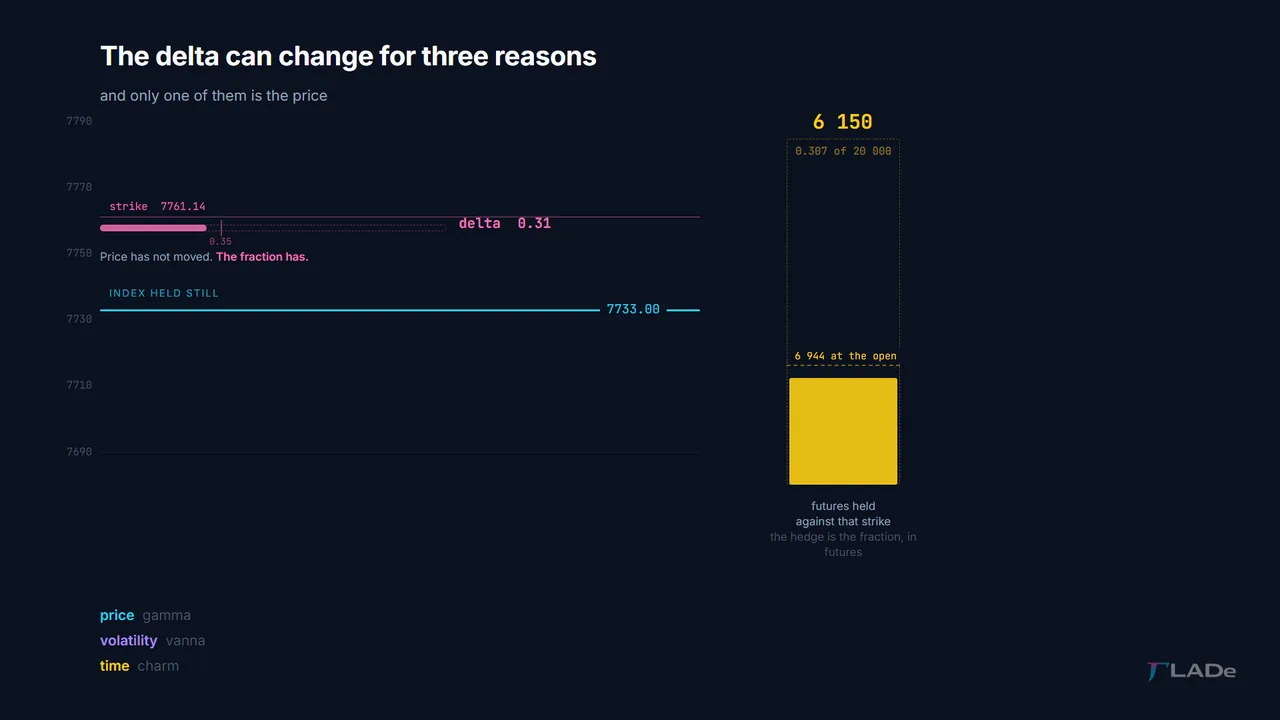
Charm: the hedge changes as time passes
One strike, under the microscope again. Twenty-eight points above where the index is sitting, with ten thousand contracts open on it — a strike off a real board, and the number of contracts is an assumption, stated on the screen as one.
The desk is counted as holding those calls, by the convention every model of this kind uses: calls counted as held, puts counted as sold. It is a convention and not knowledge, and everything directional in this chapter rests on it. I will come back to that.
At the opening bell the option moves about thirty-five hundredths of a point for every point of index. So against ten thousand contracts the desk is short just under seven thousand futures — short, because it is counted long the calls, and futures are how the exposure gets cancelled.
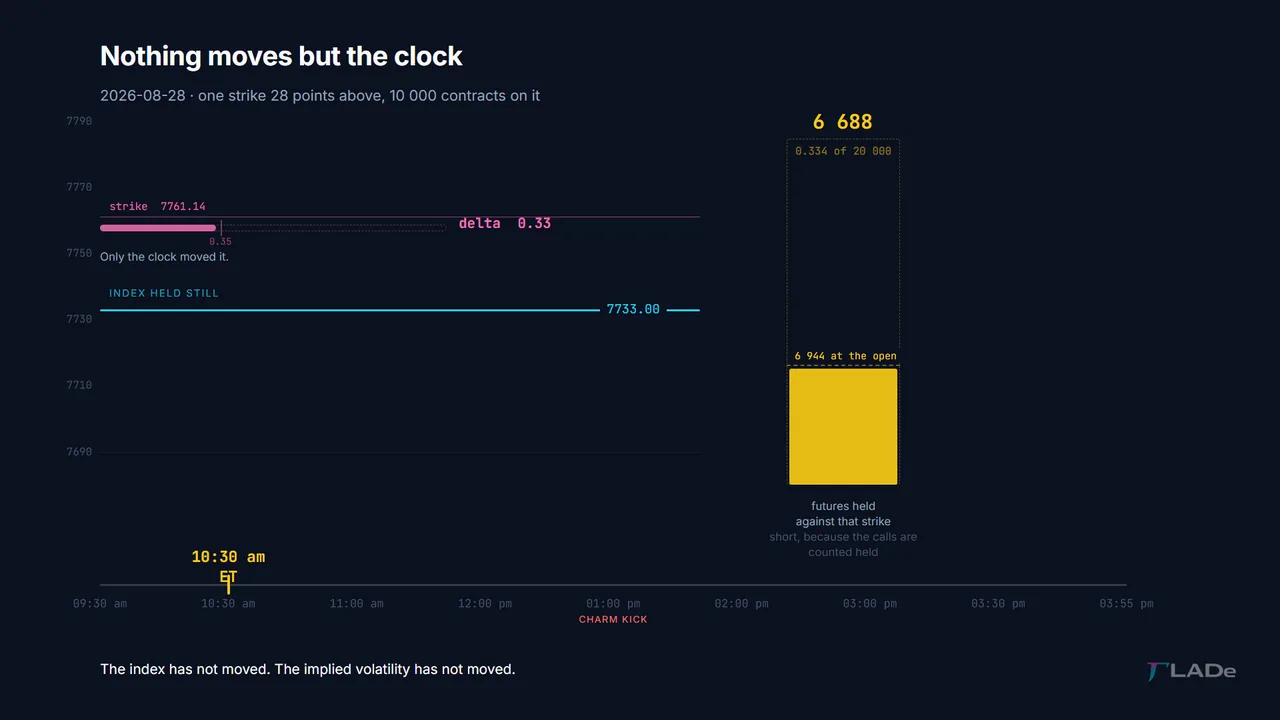
Now freeze the index at that price. Freeze the implied volatility too. Let only the clock run.
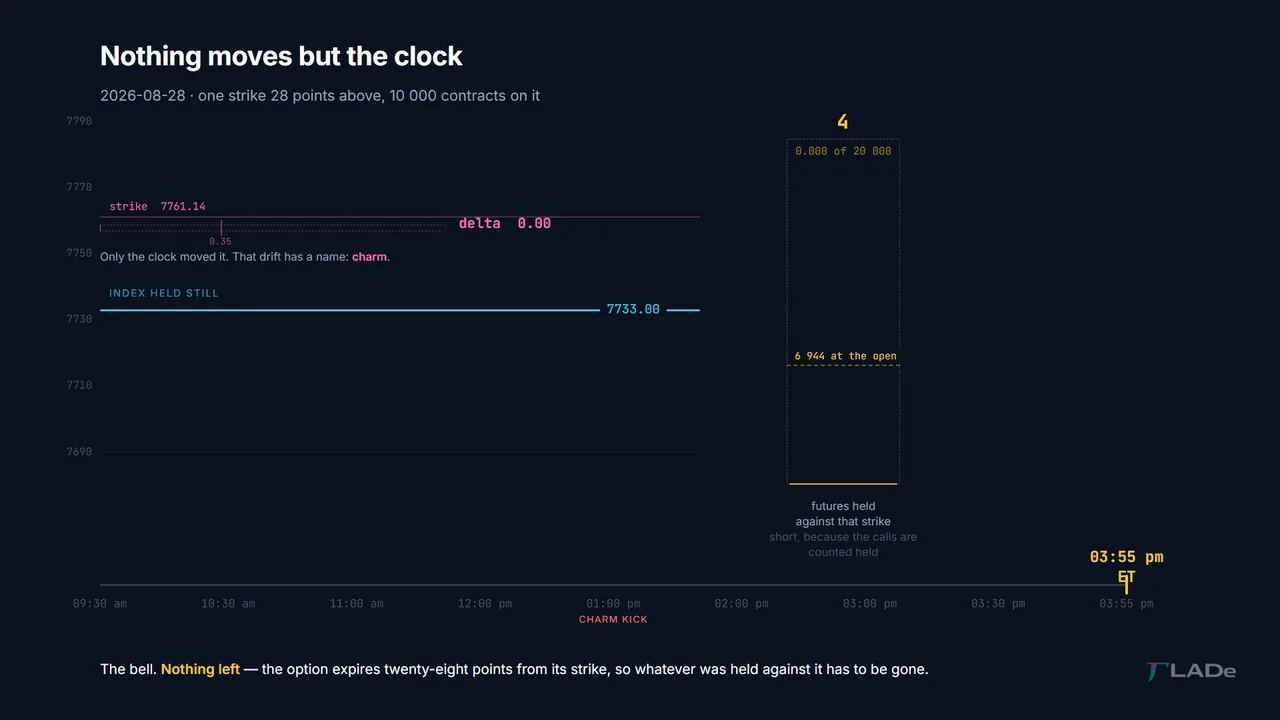
At one in the afternoon the same option moves twenty-eight hundredths instead of thirty-five, and the position against it is five thousand six hundred futures. At three o'clock, fifteen hundredths, and three thousand one hundred futures. At the bell it is nothing at all, because the option expires twenty-eight points away from its strike and whatever was held against it has to be gone by then.
Nothing moved. The index finished the day where it began it, and the implied volatility never budged. And the desk bought back nearly seven thousand futures over the course of that session. Every one of them forced. None of them with a reason visible anywhere on a chart.
The name for that drift is charm.
Charm flow is quiet in the morning and heavy into the close
The total is not the interesting number. The schedule is.
Between the opening bell and midday, that position moves by eight hundred futures out of seven thousand — a ninth of it. Between one o'clock and the close, four fifths of it.
That is one strike, on one board, at one level of implied volatility. The fraction is not a constant and I am not offering it as one. The shape is the general part: this flow is quiet in the morning and it is not quiet late.
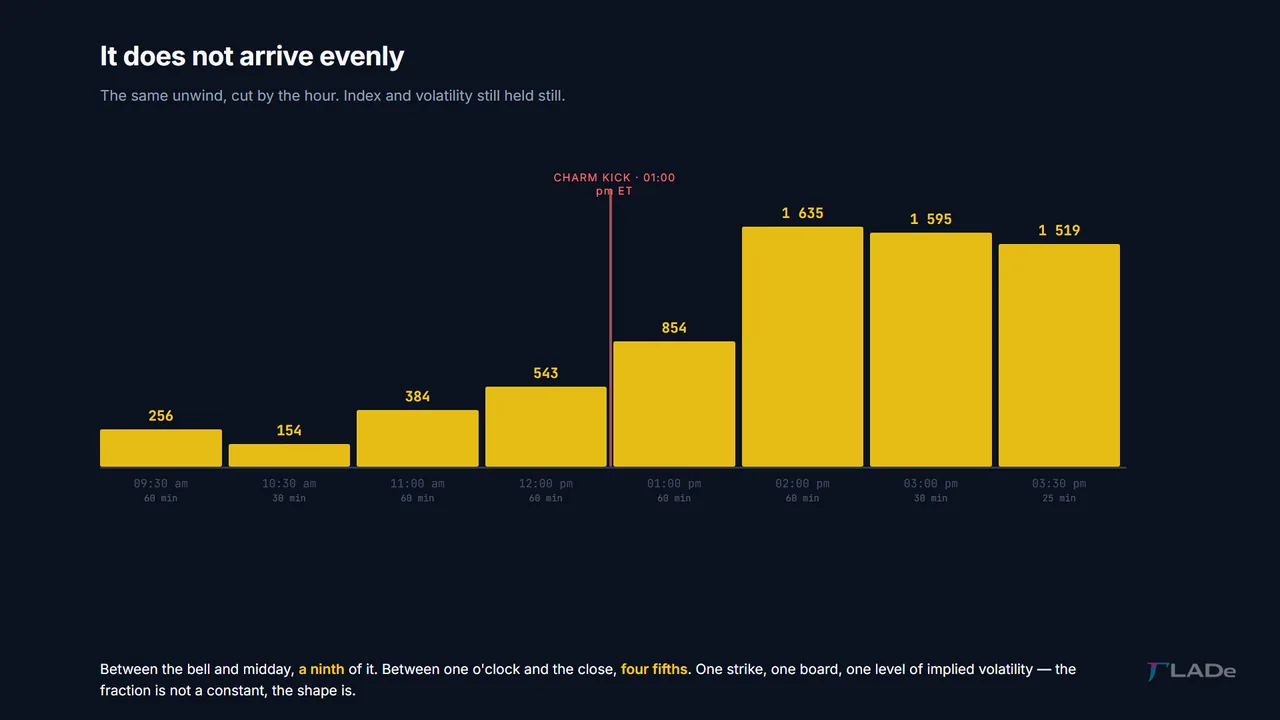
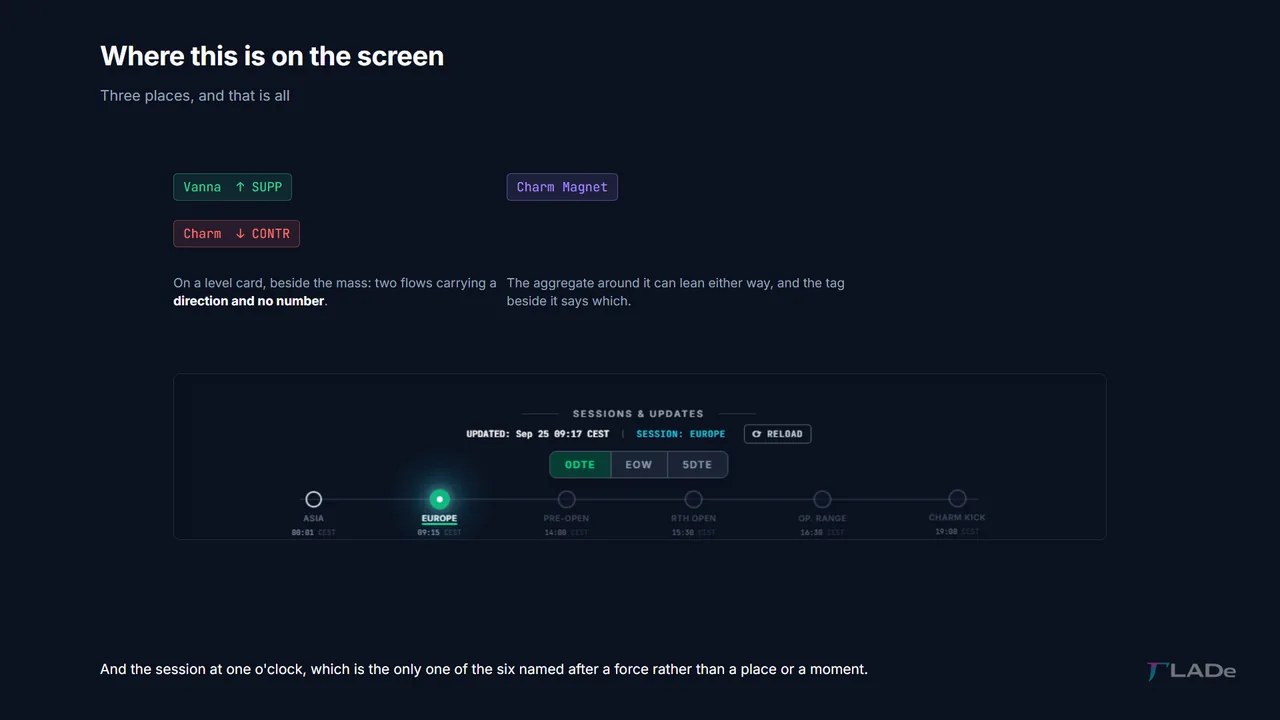
Which is why there is a session on the terminal's timeline at one in the afternoon, and why it is the only one of the six named after a force rather than a place or a moment. It is called the Charm Kick. A board photographed at one o'clock is a board with most of this still in front of it.
Charm on the strikes price is already past
Same stillness, same clock, a strike twenty-eight points below the index instead of above.
That option is decided in the other direction, so time runs it the other way. It begins the day moving about two thirds of a point per point of index and ends it moving the whole point. The desk finishes holding the most it will ever hold against that strike — twenty thousand futures against ten thousand contracts — and it got there by selling nearly seven thousand more over a session in which nothing happened.
So the clock does not push the hedge one way. It pushes every option on the board toward one of its two ends: either price finished past the strike and the hedge is complete, or it did not and the hedge is gone. Nothing is left undecided at the bell, because there is nothing left to decide it.
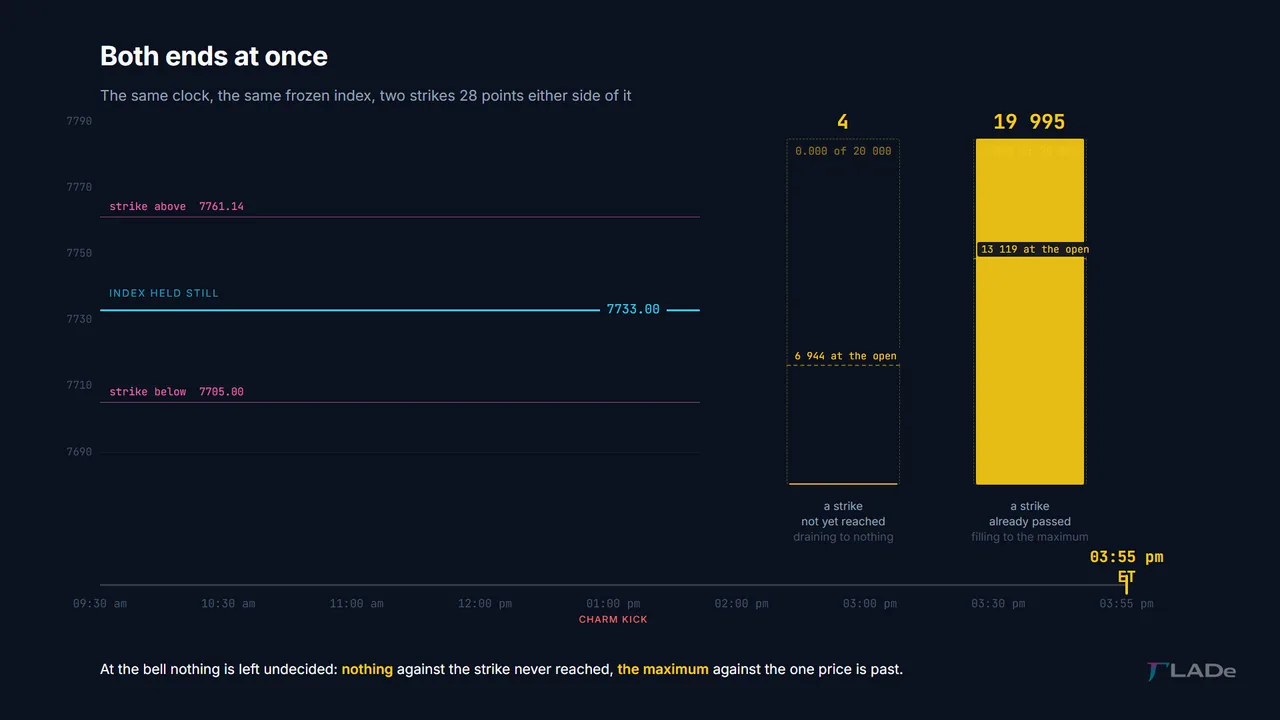
Time is the dial that settles things.
Vanna: the hedge changes when implied volatility changes
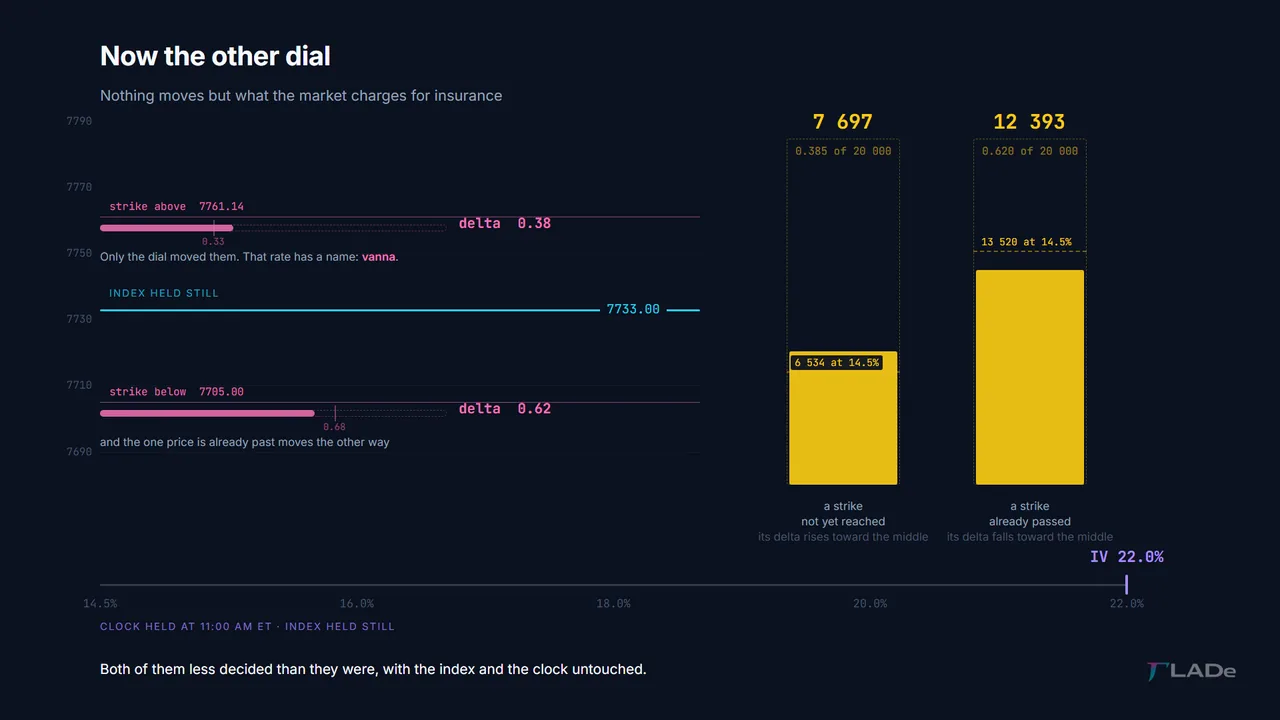
Put the clock back to eleven in the morning. Hold the index at the same price. Change one thing: what the market charges for insurance. Implied volatility goes from fourteen and a half to eighteen.
The strike has not moved. The hour has not moved. The option now moves thirty-six hundredths of a point instead of thirty-three, and the desk sells six hundred and fifty more futures against it.
The reason is almost arithmetic. That option needs twenty-eight points to finish in the money, and the market has just agreed that twenty-eight is less of a journey than it thought this morning. The contract has become less decided. And the strike below the index — the one that was nearly settled — becomes less decided as well: its fraction falls back from sixty-eight hundredths toward the middle.
The name for that is vanna.
Charm and vanna pull in opposite directions
That is the whole of it, and it is worth one line, because the line is the chapter.
Time pushes every delta on the board toward one of its ends: nothing, or the whole point. A rise in implied volatility pulls all of them back toward the middle. Same board, same contracts, same price. One dial settles, the other unsettles, and the hedge is the number they both land on.
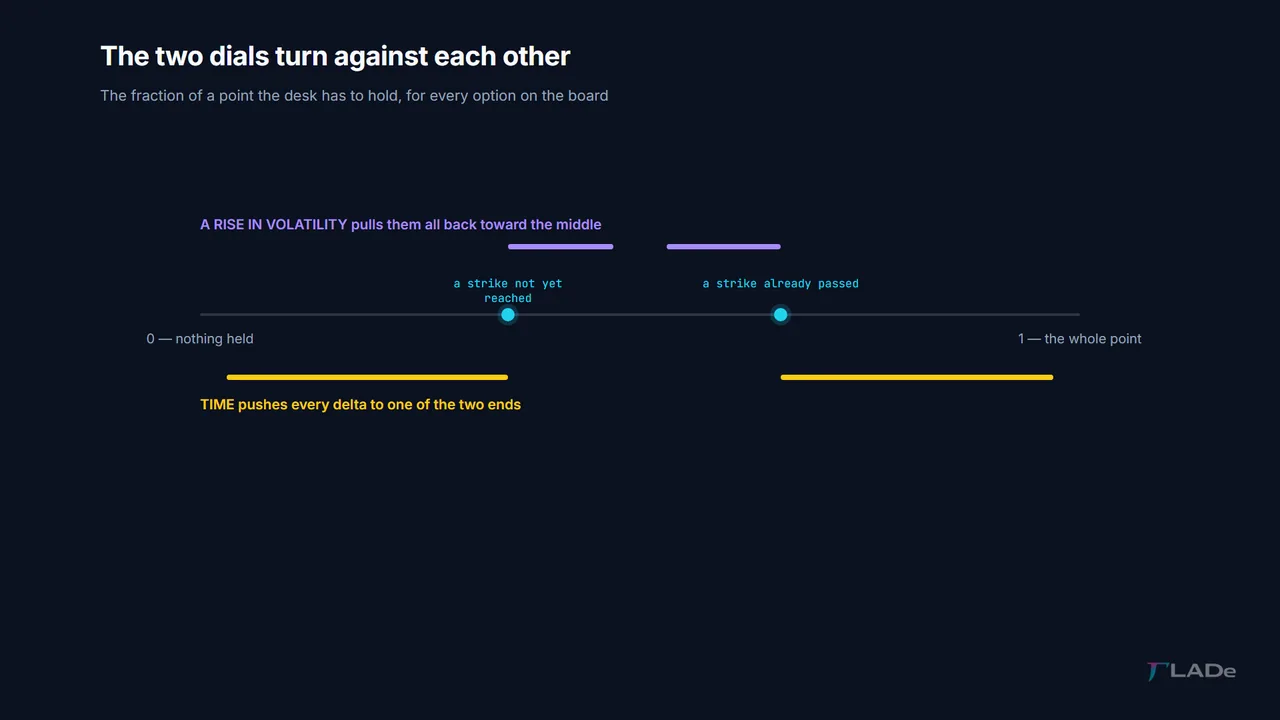
Which is also why a fall in implied volatility is not a quiet event. It does what the clock does, and it is not bound to the clock's pace.
Charm and vanna across the whole board
One strike is a microscope. The board is all of them at once, and it adds these up the same way it adds the gamma: calls counted held, puts counted sold.
That has a consequence worth checking with a pencil. At one strike and one expiry, with the same open interest in calls as in puts, both of these vanish. Exactly — at every hour, and at every level of volatility. The two sides need the same hedge in opposite directions, so the clock has nothing to move and neither does a change in volatility. The flow comes from the imbalance, never from the mass.
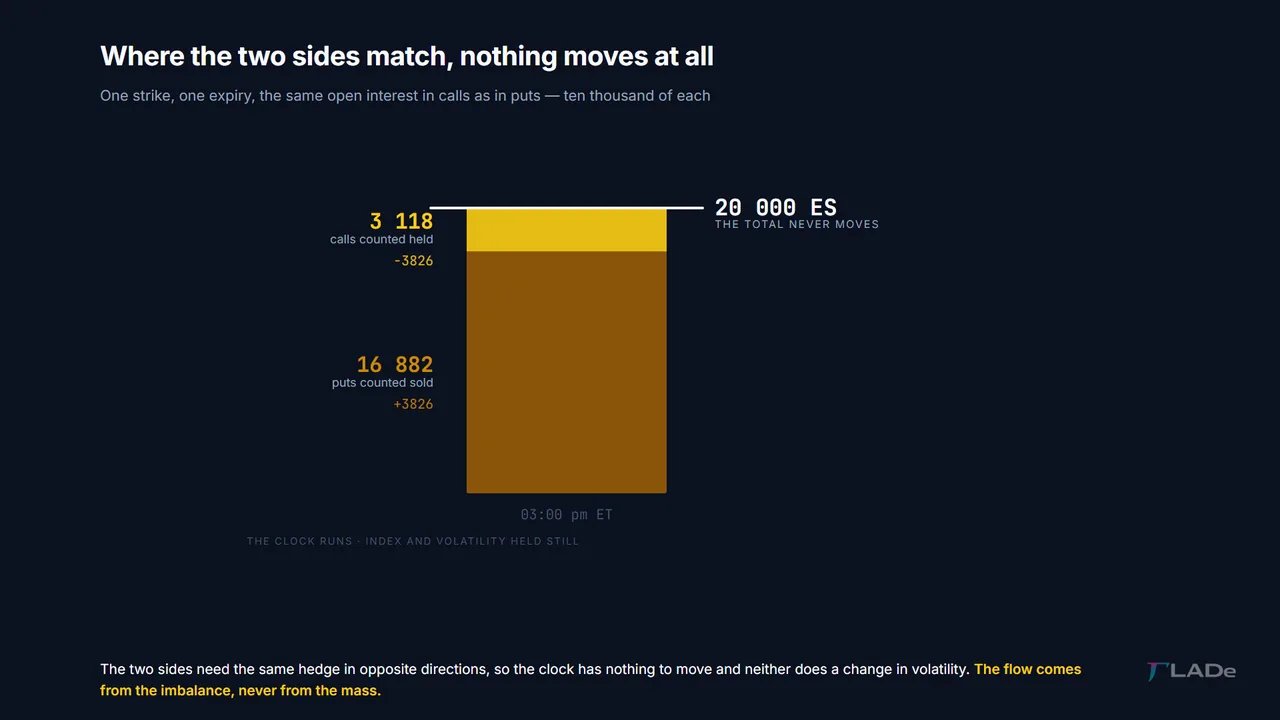
Which is the same thing the gamma sum does at such a strike, and the same question the previous chapter raised and left standing. It is still standing.
Under that same convention the directions follow, and they are not symmetric. At a strike where the calls dominate, the clock's flow runs toward the strike: buying while price is below it, selling while price is above it. At a strike where the puts dominate, it runs away from it. A rise in implied volatility does the opposite of both.
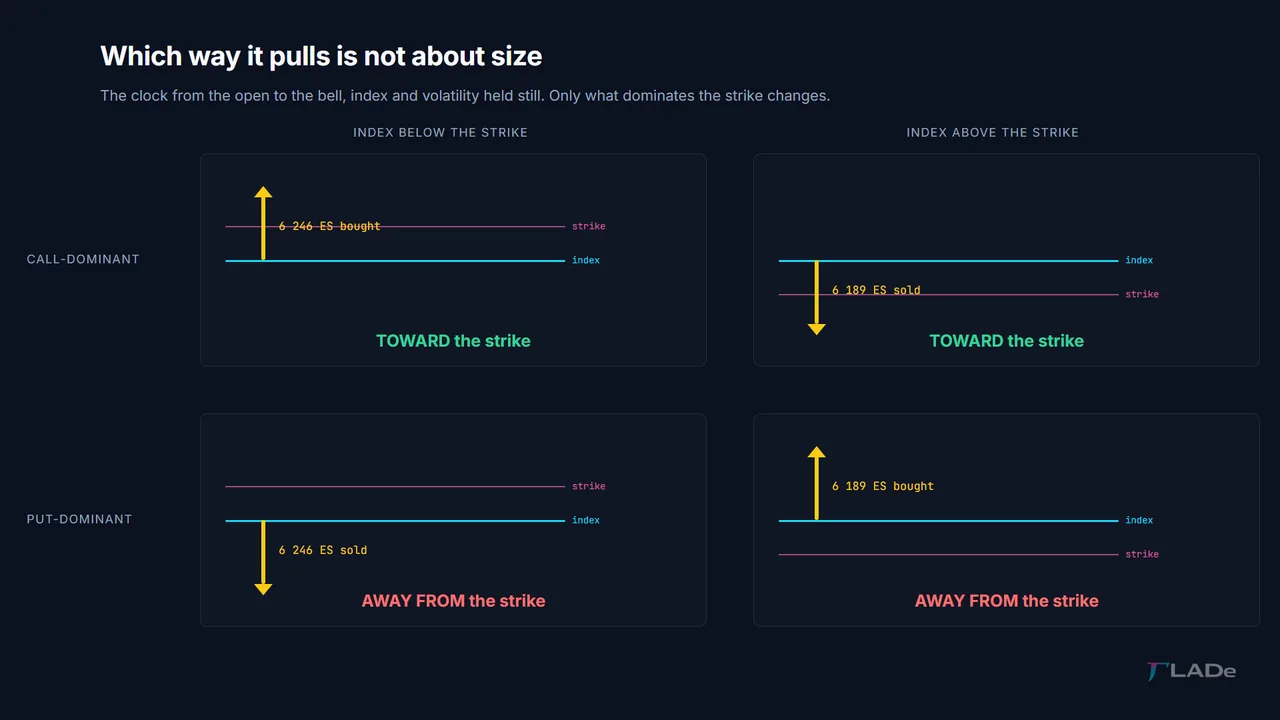
Every direction in that paragraph is the convention's, not the chain's. Open interest still carries no signature. It is the one assumption in all of this, and it is better repeated than buried.
Where charm and vanna appear on the terminal
Three places, and that is all.
On a level card, beside the mass, two flows carry a direction and no number: vanna and charm. The direction is published; the figure behind it is not.
Second, a level tagged as the Charm Magnet. The aggregate around it can lean either way, and the tag beside it says which way it is leaning.
Third, the session at one o'clock.
What the three dials cannot do
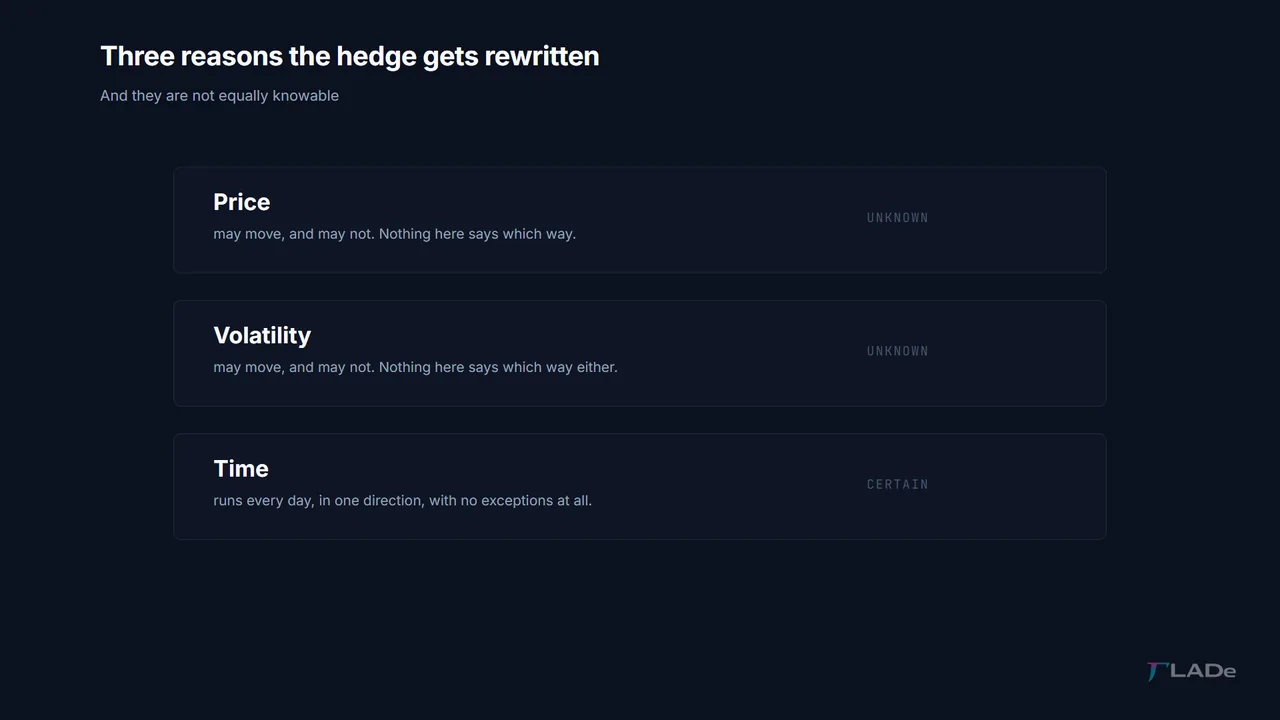
Three reasons the hedge gets rewritten, and they are not equally knowable.
Price may move and may not, and nothing here says which way. Implied volatility may move and may not, and nothing here says which way either. The clock runs every day, in one direction, with no exceptions at all.
Of the three forces that rewrite the hedge, exactly one is certain — and it is the one no candle ever shows.
That is also the end of what can be claimed. This is still a flow that has to happen, mixed into everything that chooses to, and it is still a fraction of what trades. One of the three dials can be read before it turns. None of the three says what the session will do about it.
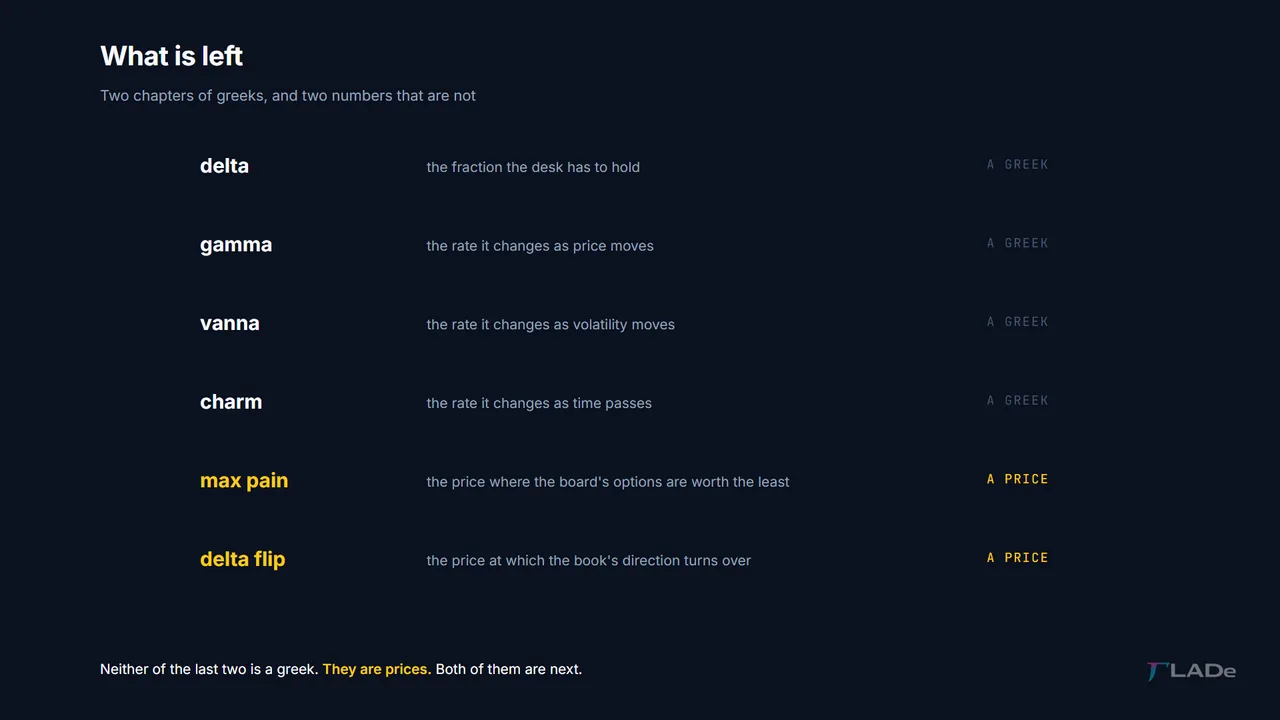
What is left: the levels that are not greeks
Those two chapters are the greeks: a fraction, the rate at which it changes, and the two things other than price that change it.
What is still on that screen are the numbers that are not greeks at all — the price where the board's options are worth the least, and the price at which the direction of the book turns over. They are prices. Both of them are next.