Why the options market matters if you trade futures
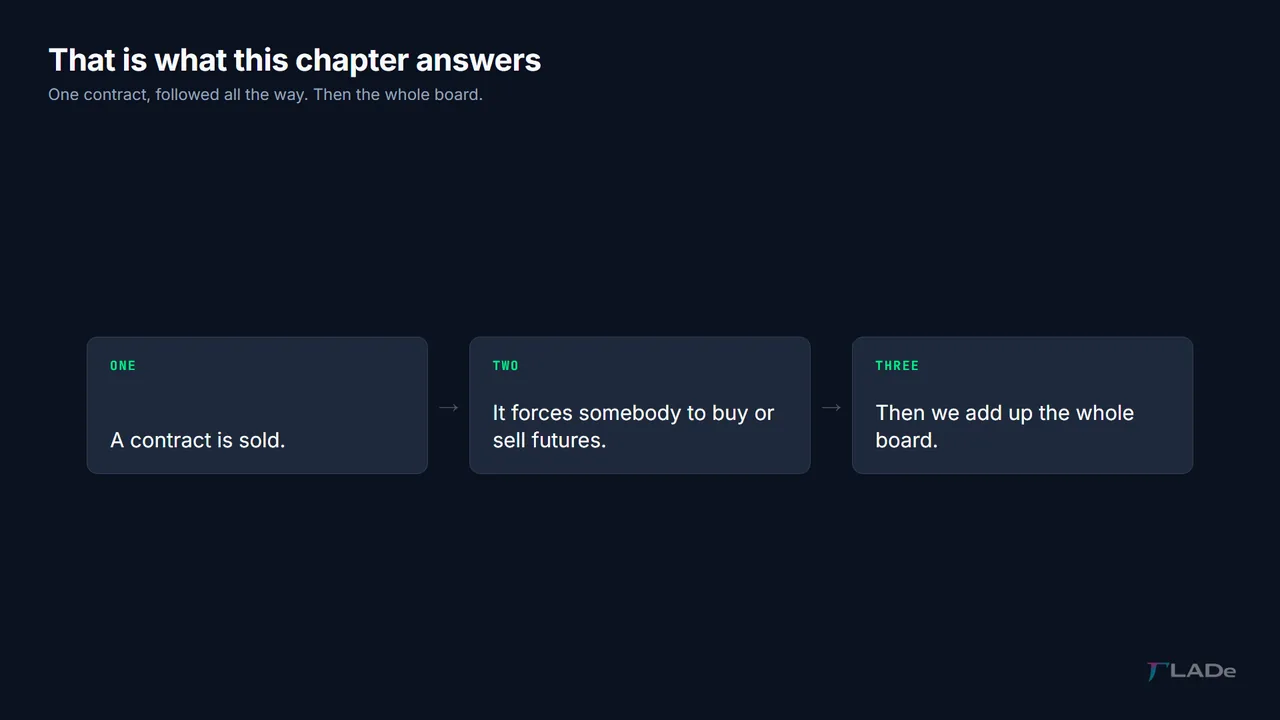
Say you trade the futures and have never touched an option. So why should the options market matter to you at all?
That is what this chapter answers. We follow one contract from the moment it is sold to the moment it forces somebody to buy or sell futures. Then we add up the whole board.
How an option sale becomes a futures trade
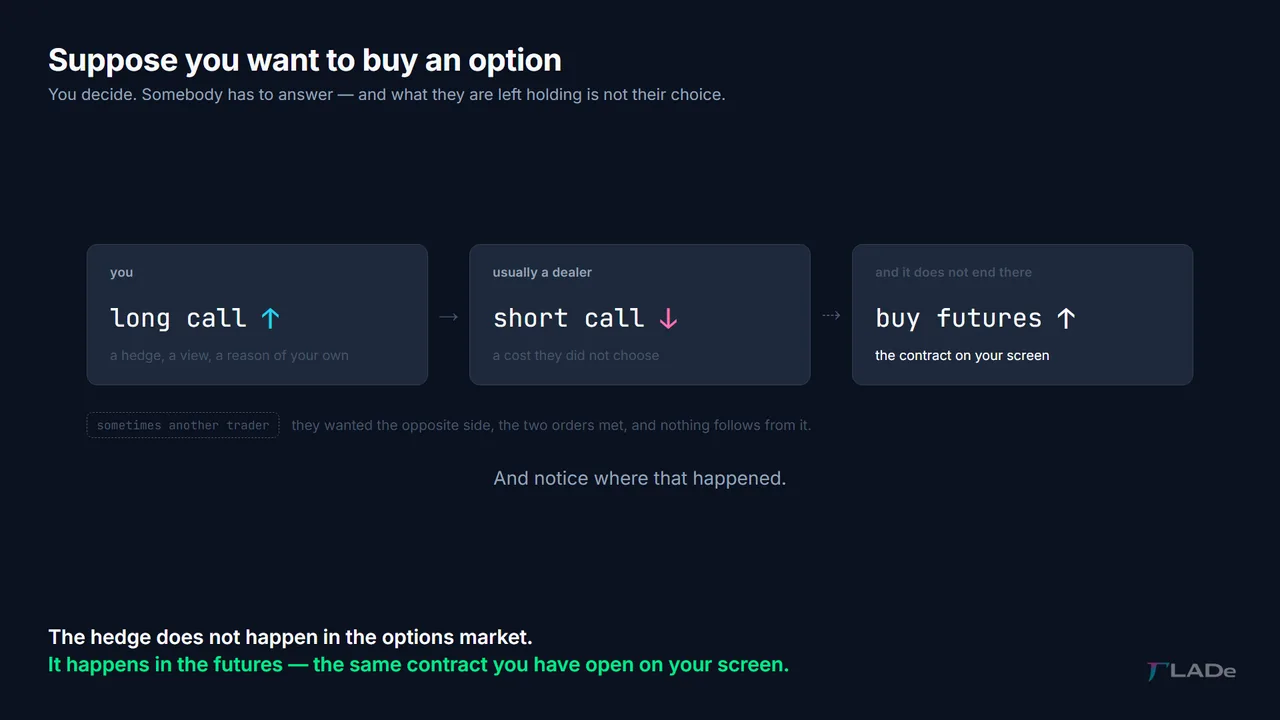
A call on the index. Why does not matter: a hedge, a view, a reason of your own.
So you need somebody to sell it to you.
Sometimes that is another trader who decided the opposite way. Then it is a trade, and nothing follows from it.
Usually it is a firm that quotes prices for a living. They did not want your call and they have no opinion about the index. They took an order, the way a supplier takes a contract, and they are paid a very small amount for filling it.
You do not choose which of the two it is. Follow the second, because it is the one that leaves something behind.
Now look at what they are holding. They are short a call. If the index climbs, that call has a cost, and they are the ones who owe it. They did not choose that.
So they get rid of it. Short a call costs them if the index rises, so they buy futures. What they make on one side pays for what they lose on the other.
Why futures? Because a future moves one for one with the index and does nothing else. Buy the right amount and the problem is gone, with nothing new to manage.
And notice where that happened. Not in the options market. In the futures — the same contract you have open on your screen.
What an option is worth as the index moves
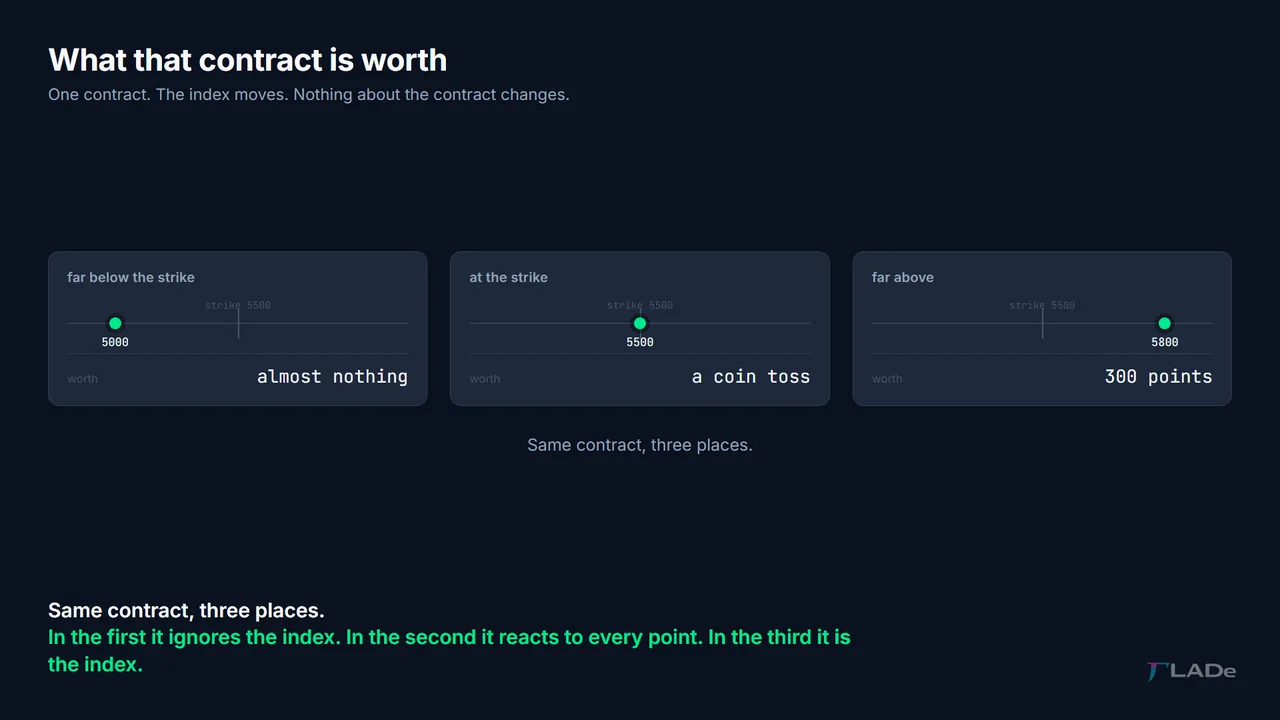
One contract. The index moves. Watch what happens to it.
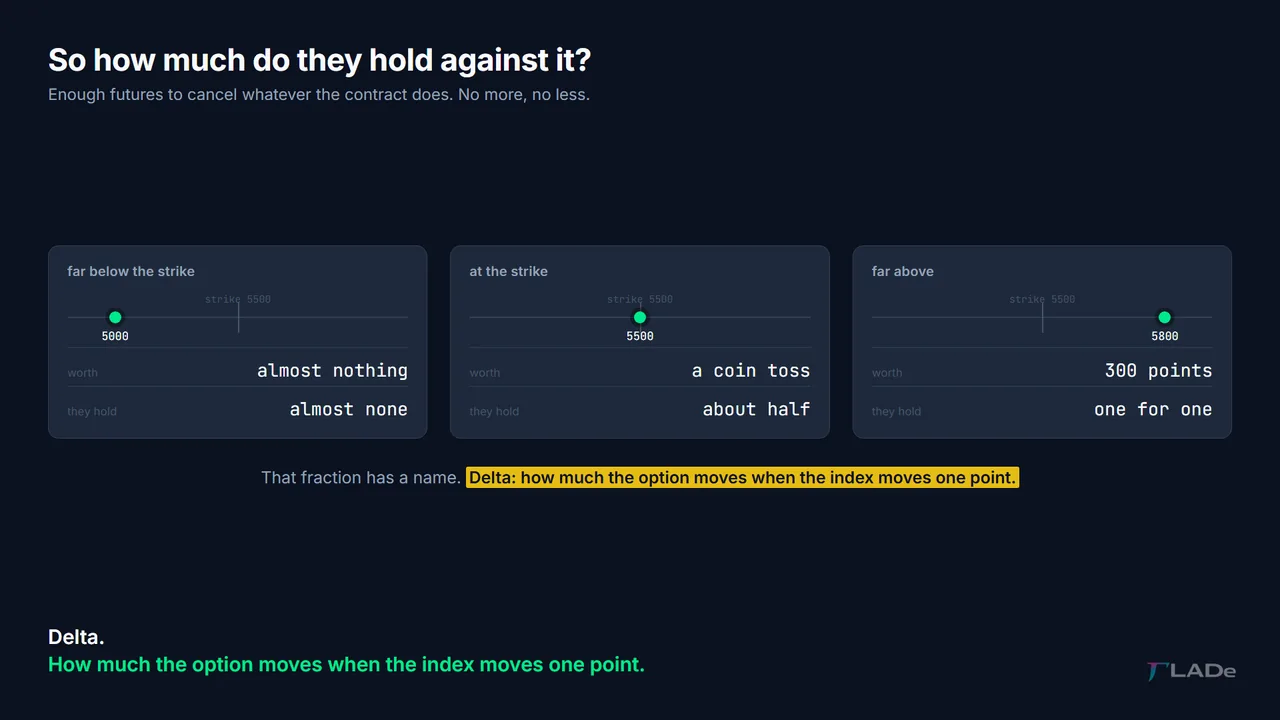
Far below the strike, it is worth almost nothing, and a ten-point move changes almost nothing. It was never going to pay, and it still is not.
At the strike, it is a coin toss, and ten points moves a large share of what it is worth.
Far above, it is worth three hundred points and it moves point for point with the index. It has stopped being an option.
Same contract, three places. In the first it ignores the index. In the second it reacts to every point. In the third it is the index.
Delta: how many futures the dealer holds against an option
They are short that contract. They need enough futures to cancel whatever it does — no more, no less.
Far below the strike, almost none. Far above, one for one. Near it, somewhere in between, and moving.
That fraction has a name. Delta: how much the option moves when the index moves one point.
So the hedge is arithmetic. Add up the delta of everything on the book, buy or sell that much in futures, and the book is flat.
Except it does not stay flat.
Gamma: how often the hedge has to be redone
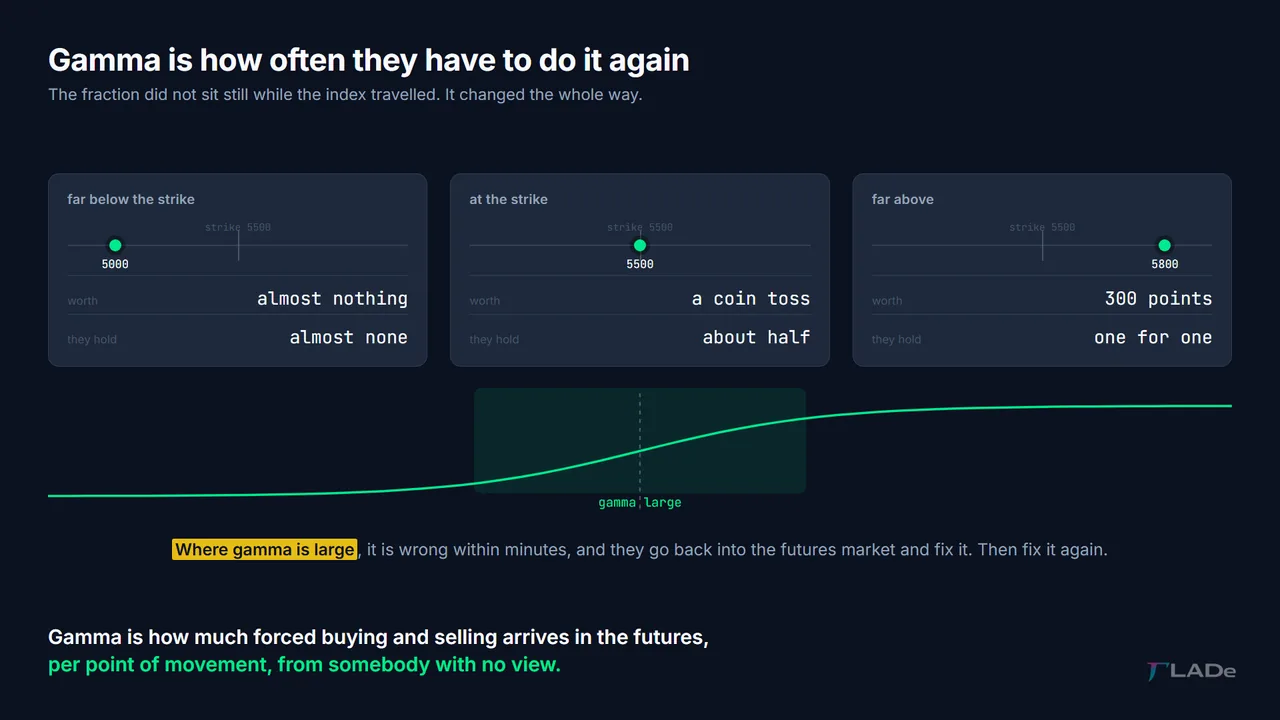
The fraction did not sit still while the index travelled. It changed the whole way.
So there is a second number, and it is simply how fast the first one moves. It is called gamma.
Where gamma is small, this morning's hedge is still roughly right this afternoon. Where gamma is large, it is wrong within minutes, and they go back into the futures market and fix it. Then fix it again. Every trip costs something.
So gamma is not an abstraction. It is the reason a Greek letter that belongs to somebody else is your business:
Gamma is how much forced buying and selling arrives in the futures, per point of movement, from somebody with no view.
Long gamma or short gamma: which way the hedging goes
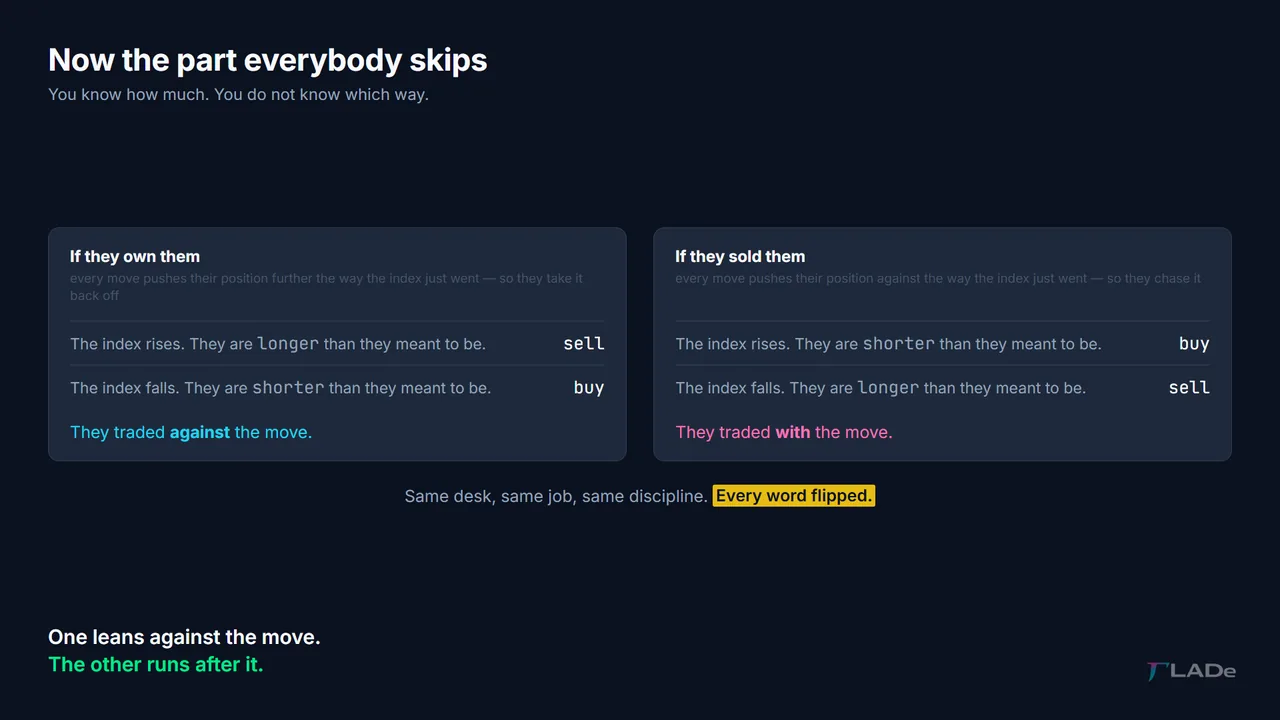
You know how much. You do not know which way.
It depends on one thing: whether they own those options or sold them.
If they own them, every move pushes their position further the way the index just went. So they take it back off.
- The index rises. They are longer than they meant to be. They sell.
- The index falls. They are shorter than they meant to be. They buy.
They traded against the move.
If they sold them, every move pushes their position against the way the index just went. So they chase it.
- The index rises. They are shorter than they meant to be. They buy.
- The index falls. They are longer than they meant to be. They sell.
They traded with the move.
Same desk, same job, same discipline. Every word flipped.
One leans against the move. The other runs after it.
Dealer positioning is not the dealer's decision
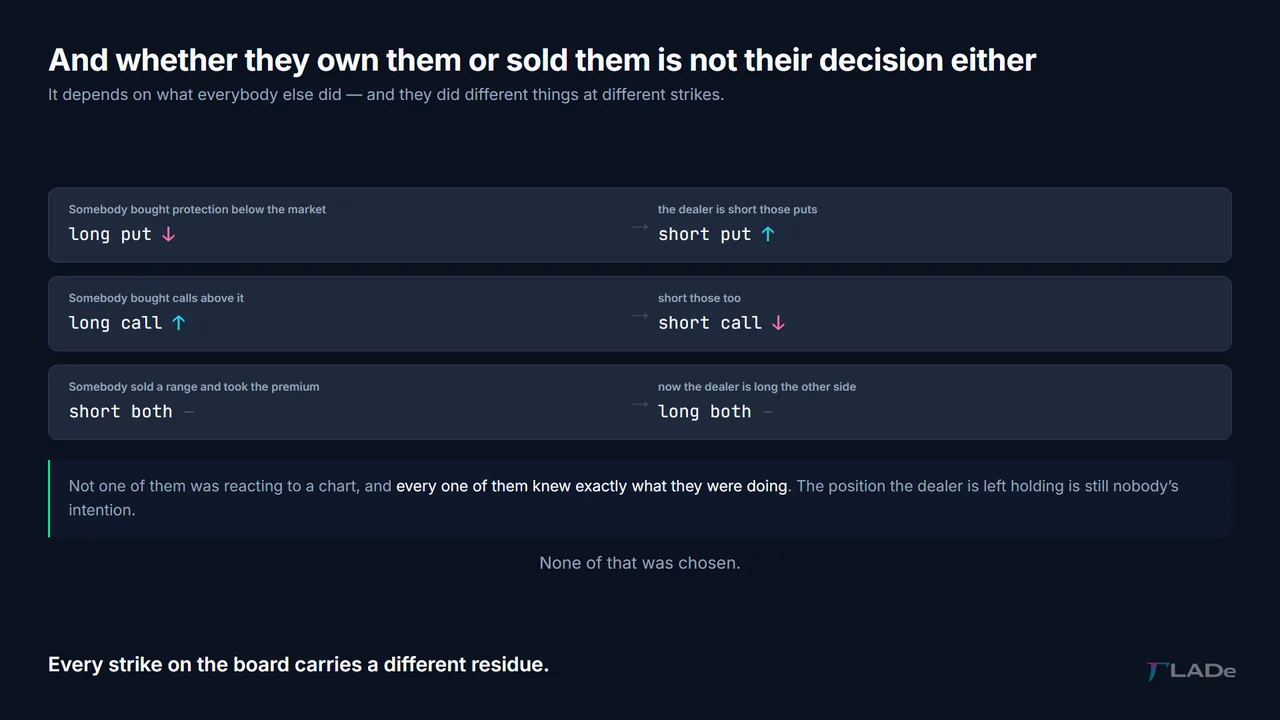
It depends on what everybody else did, and they did different things at different strikes.
Somebody bought protection below the market: the dealer is short those puts. Somebody bought calls above it: short those too. Somebody sold a range and took the premium: now the dealer is long the other side.
None of that was chosen. Who left it there, and why, is the previous chapter's story. What matters here is what it leaves behind.
Every strike on the board carries a different residue.
And here is the honesty. We cannot see which strategy put the contracts there. So when anybody, including us, tells you the sign at a strike, that sign rests on an assumption about whose book is on the other side. It is stated, it is applied the same way everywhere, and it is not knowledge.
What gamma exposure (GEX) is
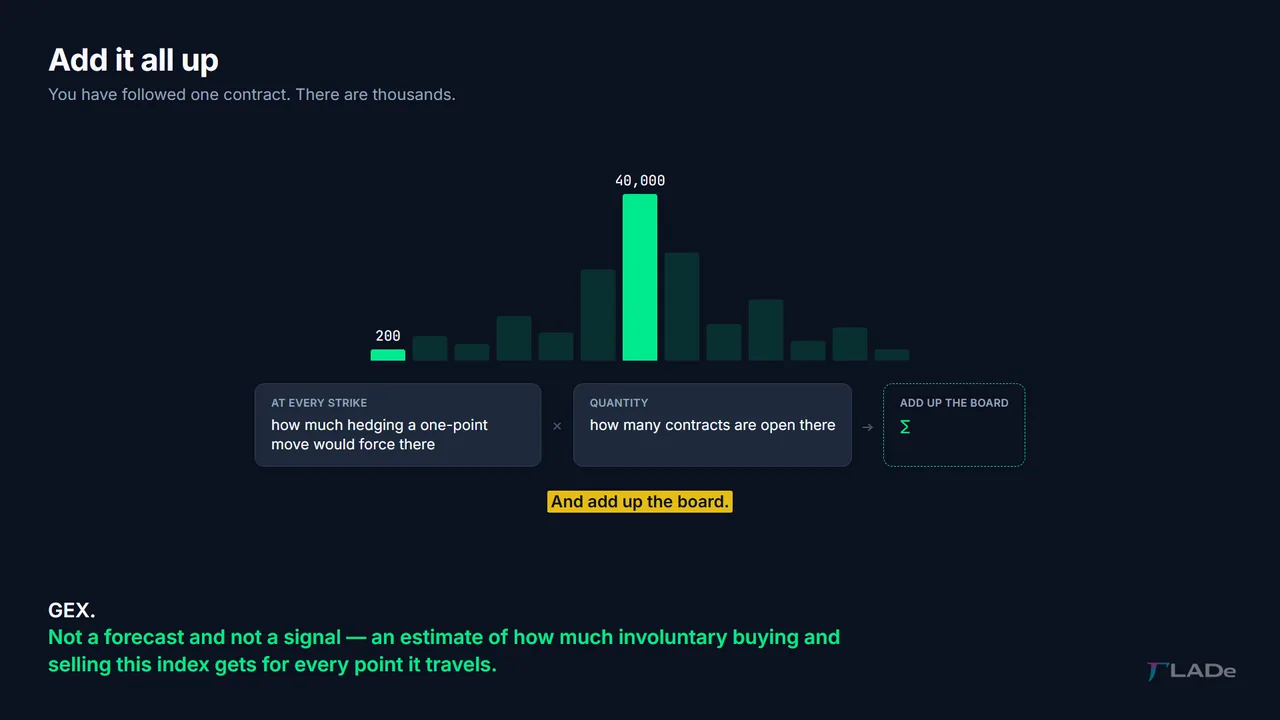
You have followed one contract. There are thousands.
Every strike has its own version of that story running at the same time. And at each one there is a quantity: how many contracts are open there. At the same distance from the price, a strike with two hundred produces a trickle and a strike with forty thousand produces a river.
So: take every strike, work out how much hedging a one-point move would force there, weight it by how many contracts are open, and add up the board.
That total is gamma exposure. GEX. Not a forecast and not a signal — an estimate of how much involuntary buying and selling this index gets for every point it travels.
Positive gamma and negative gamma
And now the sign means something you derived instead of something you were told.
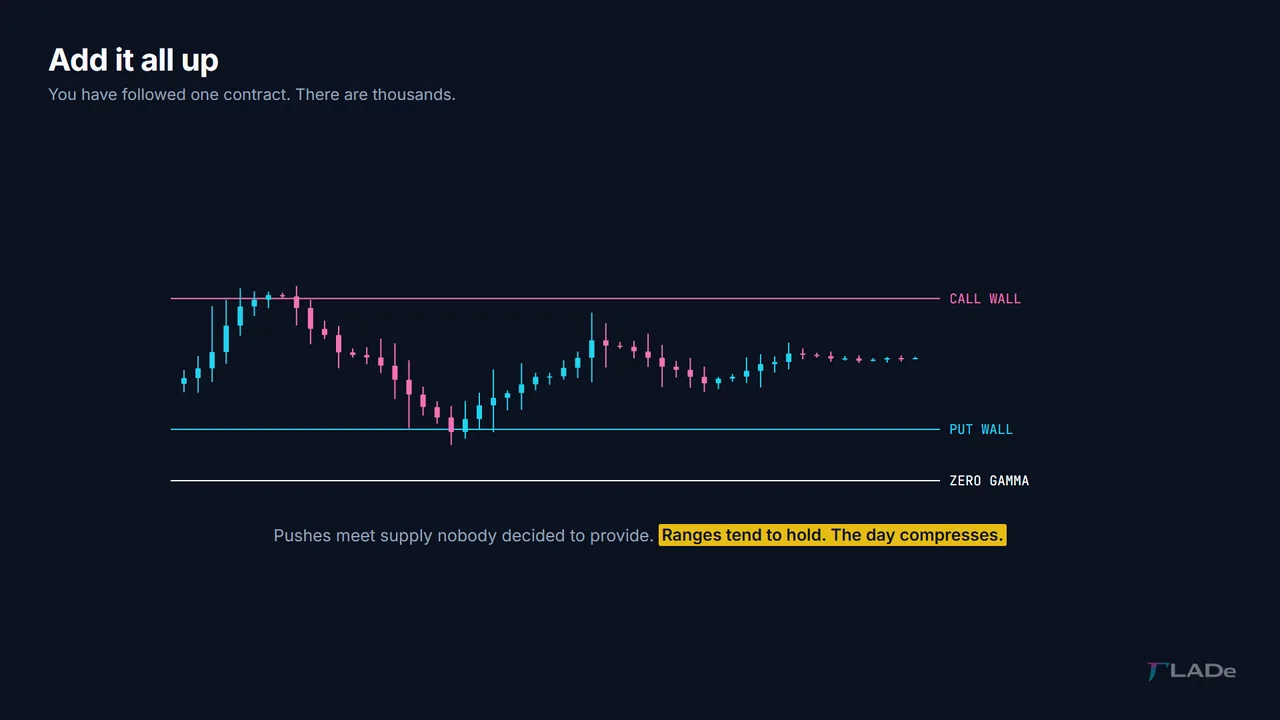
Positive. Across the board, dealers own more gamma than they have sold. The flow leans against the move: selling into strength, buying into weakness, all day, from somebody with no view. Pushes meet supply nobody decided to provide. Ranges tend to hold. The day compresses.
Shock absorbers. You hit a bump and something pushes back; you hit a hole and something holds you up. The car still goes where it is steered — it stops being thrown around on the way.
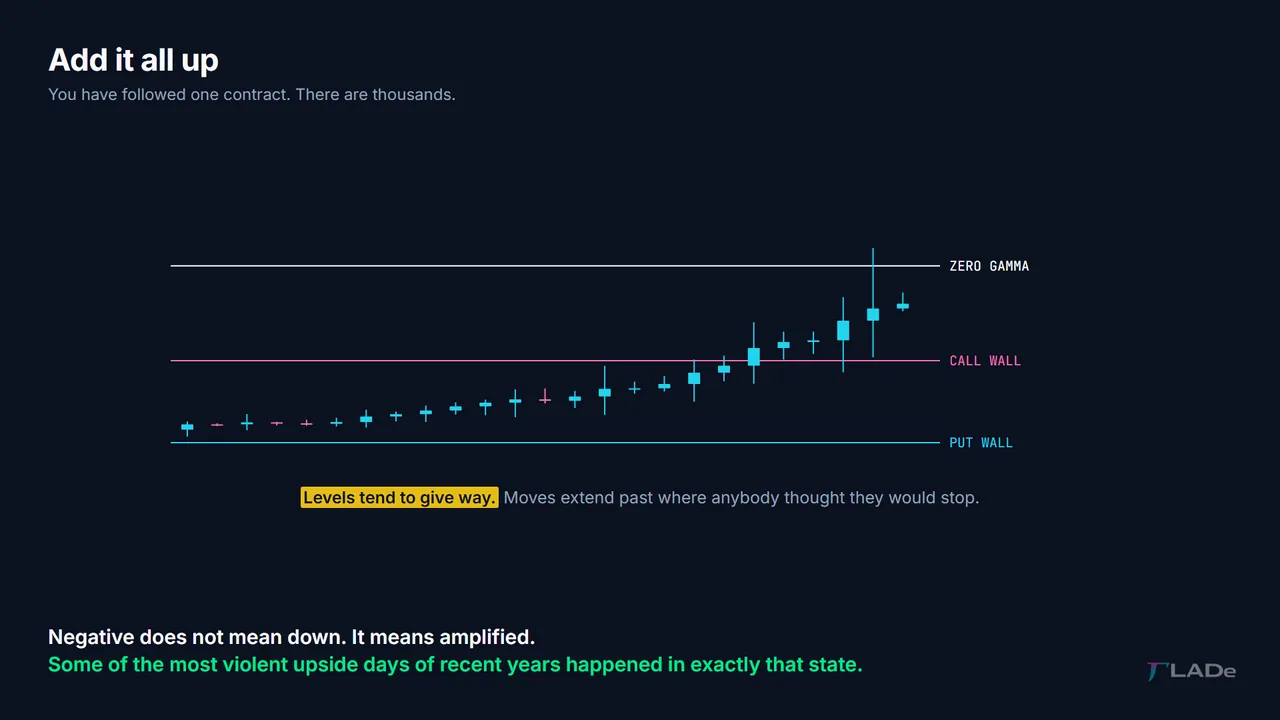
Negative. Across the board, dealers have sold more than they own. The flow runs after the move: selling as it falls, buying as it rises. Levels tend to give way. Moves tend to extend past where anybody thought they would stop.
Black ice. Nothing about the road tells you which way you are going to slide. What it does tell you is that a small input now produces a large result. A touch of the wheel that did nothing yesterday takes the whole car today.
There is your Monday and your Tuesday. Not a mood. Not the news. A sign.
And note what the negative case is not. Negative does not mean down. It means amplified. Some of the most violent upside days of recent years happened in exactly that state.
Time to expiry: the clock is a variable
All of this would be simpler if a contract behaved the same way all day. It does not.
Go back to your call — the one that pays the difference above five thousand five hundred — and bring the index up to the strike. Only the calendar changes.
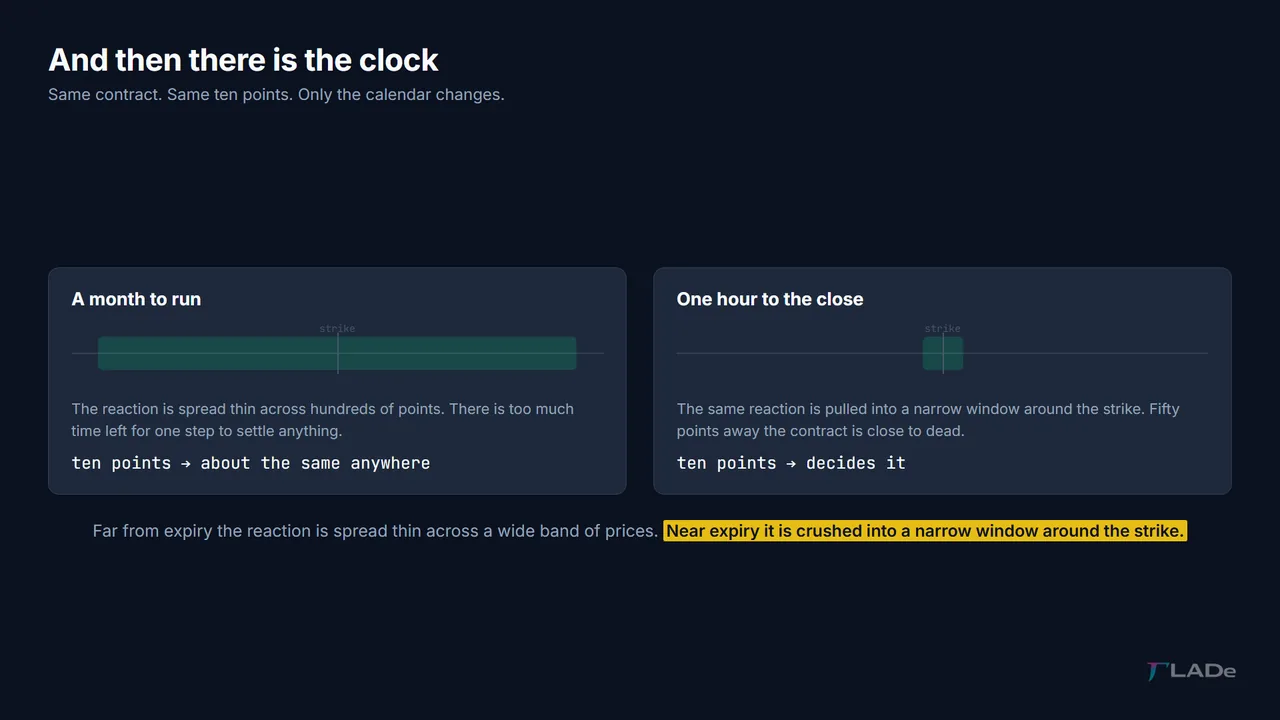
A month to run. Ten points moves it a little, and it would move it about the same anywhere nearby. There is too much time left for one step to settle anything, so the reaction is spread thin across hundreds of points.
One hour to the close. Ten points decides it. The same step that was worth a shrug a month out is now most of the argument — and fifty points away, the same contract is close to dead and ten points barely touches it.
Same contract. Same ten points. Only the calendar changed — and it pulled the whole reaction into a narrow window around the strike.
That is what time does. It does not move the level or the contract; it decides how violently the hedge reacts when the index takes a step. Far from expiry the reaction is spread thin across a wide band of prices. Near expiry it is crushed into a narrow window around the strike: inside the window, enormous; outside it, almost nothing.
Which is why same-day options are argued to have changed the character of this market rather than simply added volume to it — how much is still debated.
And there is a second half, which surprises people. The hedge has to be redone even on an afternoon when the index has gone nowhere at all — because the contracts are closer to being worth something or worth nothing than they were at lunchtime, and that alone changes what they have to hold against them.
There is a name for that drift. You do not need it yet, and it gets its own chapter later, because what it does to a single level during the afternoon is a story of its own.
What you need here is only this: the same board, with the same contracts on it, does not produce the same forces at half past nine and at three o'clock.
The clock is a variable, not a backdrop.
Why a GEX level is not one more line on the chart
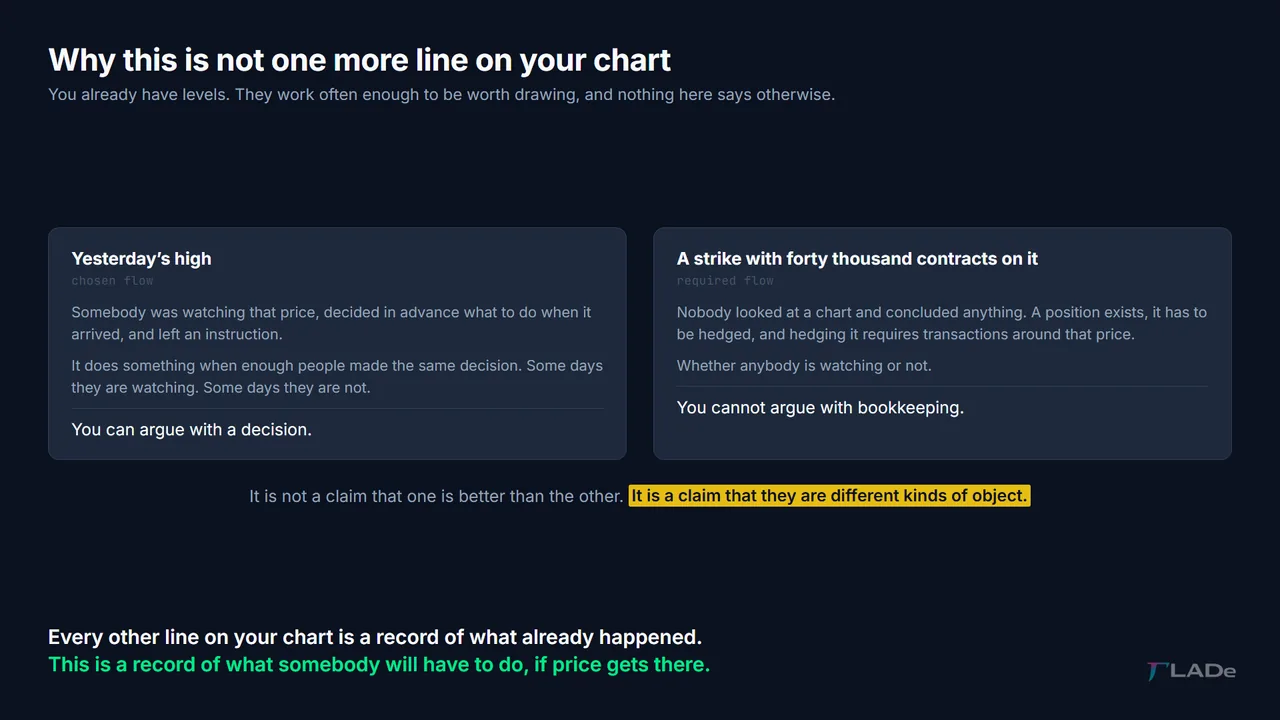
You already have levels. Yesterday's high. Last week's low. A round number. They work often enough to be worth drawing, and nothing here says otherwise.
But ask what is actually sitting at one of them.
At yesterday's high there are orders, and they are there because people put them there. Somebody was watching that price, decided in advance what to do when it arrived, and left an instruction. The level does something when enough people made the same decision. So underneath it is a bet on what other people are watching. Some days they are. Some days they are not, and the level does nothing at all.
At a strike with forty thousand contracts on it, something else is true. The flow that arrives there is not a decision. Nobody looked at a chart and concluded anything. A position exists, it has to be hedged, and hedging it requires transactions around that price whether anybody is watching or not.
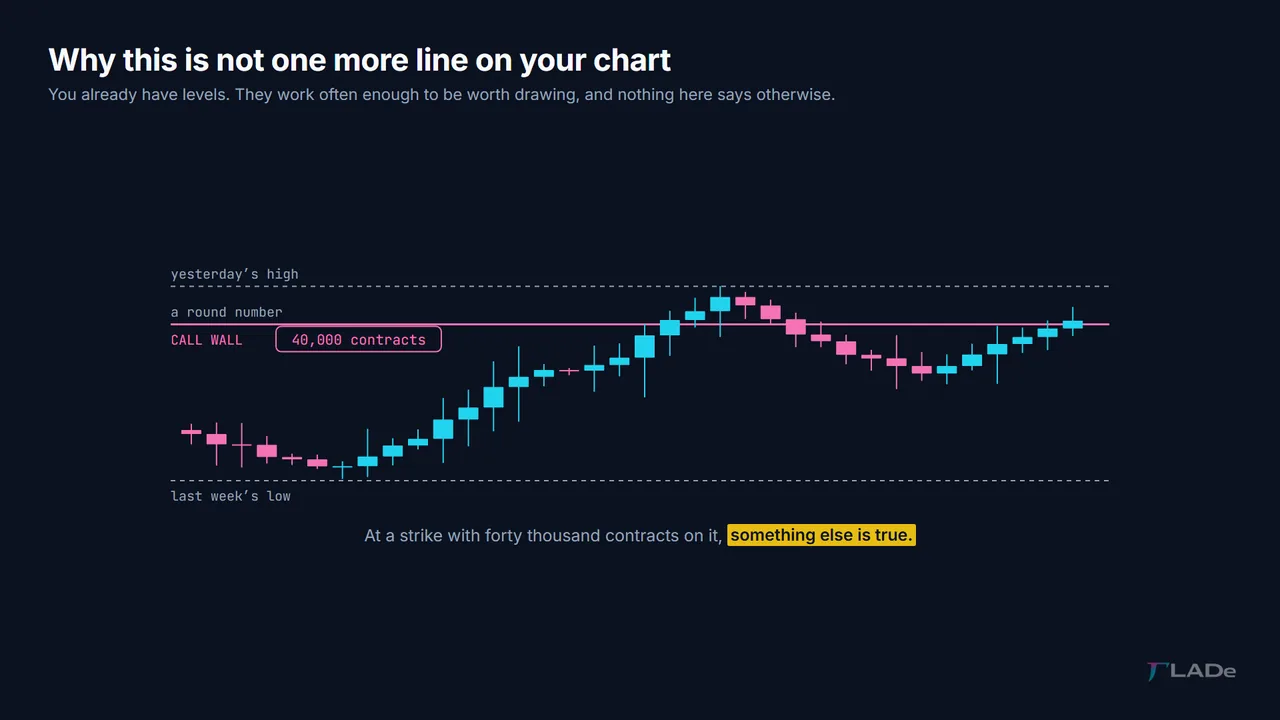
That is the whole difference, and it is not a claim that one is better than the other. It is a claim that they are different kinds of object. One is chosen flow. The other is required flow. You can argue with a decision. You cannot argue with bookkeeping.
Which is also the plainest answer to why any of this was worth your time. Every other line on your chart is a record of what already happened. This is a record of what somebody will have to do, if price gets there.