Who is in the options market on any given day
Look at who is in this market on any given day.
Pension and mutual funds, long because that is what the money was given to them to be. Hedge funds, on every horizon from a decade to an afternoon. Bank desks, some carrying risk for weeks and some flat by the close, funds that trade volatility itself and nothing else, professional independents, intraday speculators, and a very large number of people at home with an account and a view.
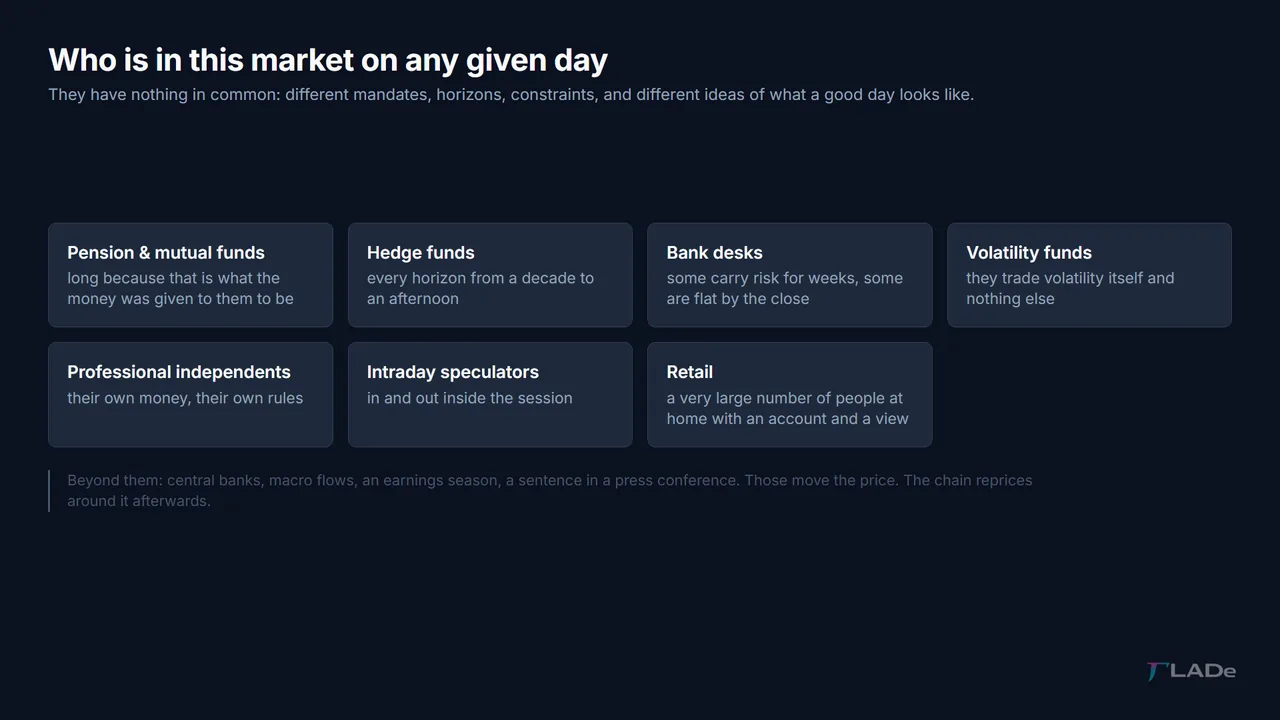
Beyond them there is everything that moves the index without ever touching an option — central banks, macro flows, an earnings season, a sentence in a press conference. Those move the price. The chain reprices around it afterwards.
The ones who do leave contracts on the board have nothing in common. Different mandates, different horizons, different constraints, different amounts of money, different ideas of what a good day looks like.
So we are not going to sort them. We are not even going to try.
What matters is what each participant is trying to get
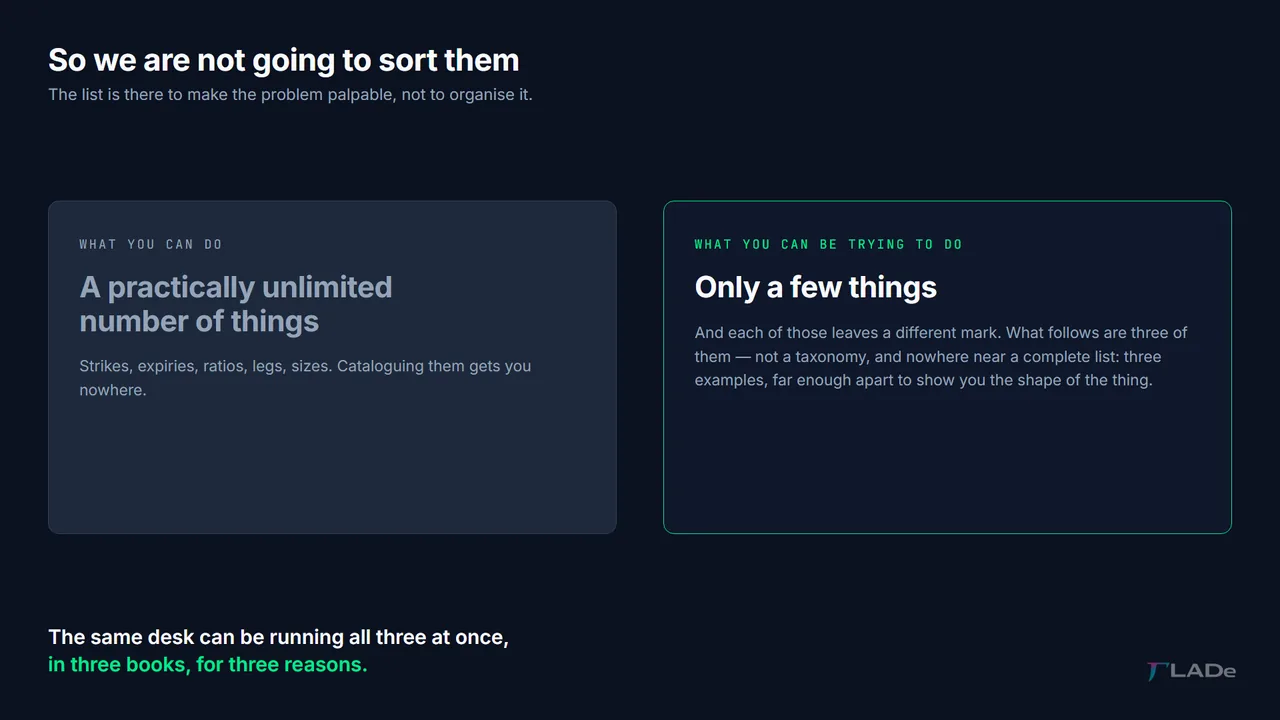
What matters is not who acted. It is what they were trying to get — because you can do a practically unlimited number of things in an options market, but there are only a few things you can be trying to do, and each of those leaves a different mark.
What follows are three of them. Not a taxonomy, and nowhere near a complete list: three examples, far enough apart to show you the shape of the thing. The same bank desk can be running all three at once, in three books, for three reasons, and change which one dominates by the afternoon.
Hedging: protect what you already hold
Imagine your approach is to stay invested.
Not because you are bullish today. Because over a long enough horizon this market has gone up, and being out of it is how you miss the part that pays. Maybe you are running other people's money and sitting in cash is not something you can explain to them. Maybe it is your own money and you simply do not want to be out.
The index is at all-time highs.
What do you do?
Sell everything? You cannot. You would be flat in a market that has risen for eleven straight months, and if you are wrong you have to buy it all back higher — in size, and in public.
So you stay. But staying at highs is uncomfortable, because the one thing you do not know is how deep the next correction goes. Five percent is noise, fifteen is a bad year, thirty is a career.
So you buy protection. And notice how you buy it: not in one block. You do not know where the correction stops, so you buy in layers — some covering a little below, more further down, a little more further still. You are not predicting the depth. You are refusing to be forced to.
That is the first strategy, and here is what it leaves on the board: puts spread across many strikes underneath the market, bought by somebody who hopes they expire worthless.
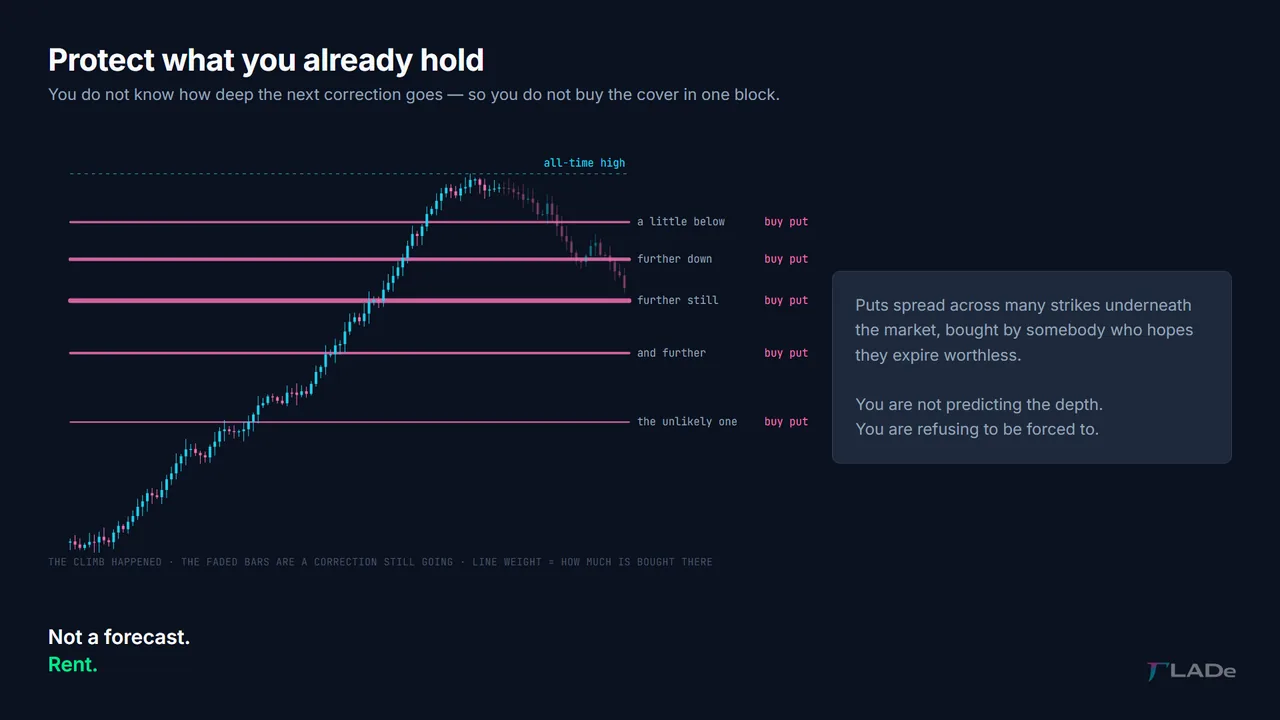
Not a forecast. Rent.
And if the protection is expensive, you may pay for it by selling something above the market you would have been happy to sell into anyway. Which is how the same hedger ends up leaving contracts on both sides of the price at once.
Selling the range: being paid whichever way it goes
Now imagine your approach is to capitalise on the day itself, regardless of where the market goes.
You are not trying to call the direction. You are trying to be paid whichever way it goes.
What do you do?
You stop asking "up or down" and you start asking "how far".
You look at what the index has been doing, you look at what options are pricing. You come out with a range: today, with some probability, this stays between a floor and a ceiling.
What trade expresses that? Not a directional one. You sell the range. You take money now from somebody who wants the right to trade at prices outside it, and you keep that money if the day stays inside — which, on the numbers, it usually does.
You may not centre that range on where the price is now. That is still not a directional bet. It is a bet on how far that happens not to be symmetric.
And because "usually" is not "always", you cap it. You buy something further out, cheaper, so that the day the range breaks it costs you a known amount instead of an unknown one. You hedge as the day moves, so that being wrong about direction costs nothing on a trade that was never about direction.
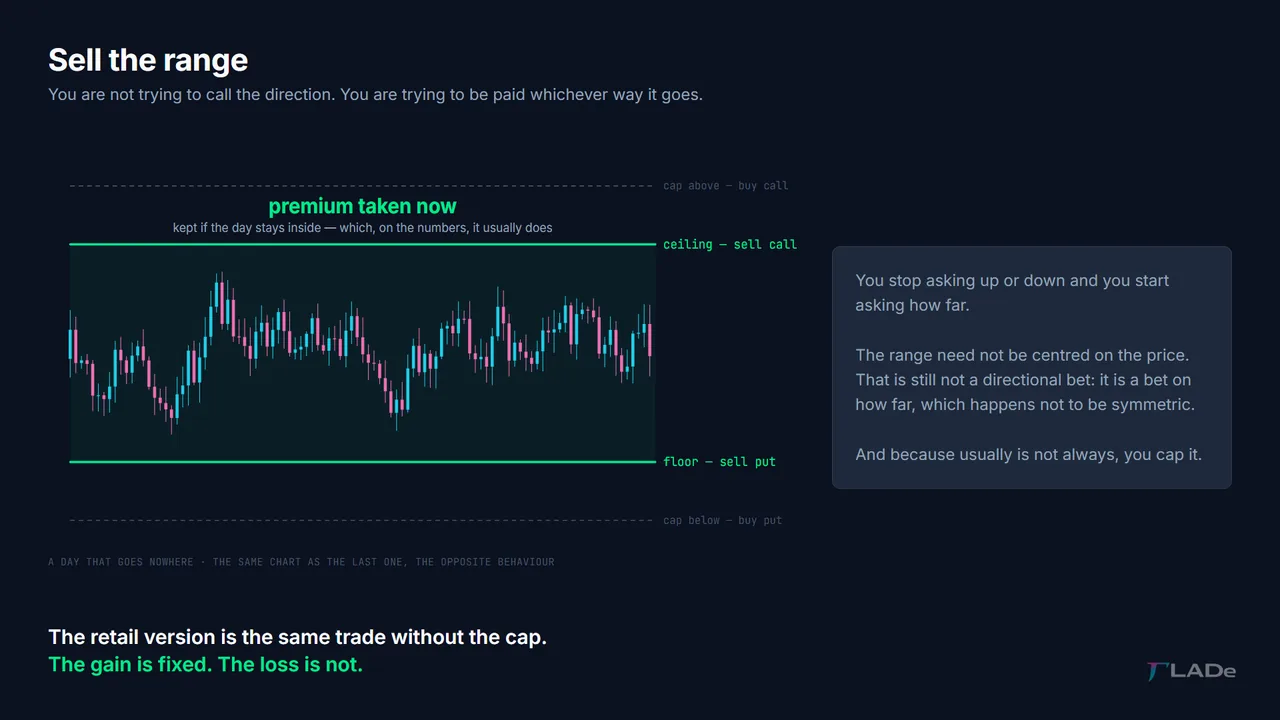
You already know the retail version of this. Selling puts to collect the premium. Same strategy, without the cap: the gain is fixed and the loss is not.
Buying calls and puts: the move without the index
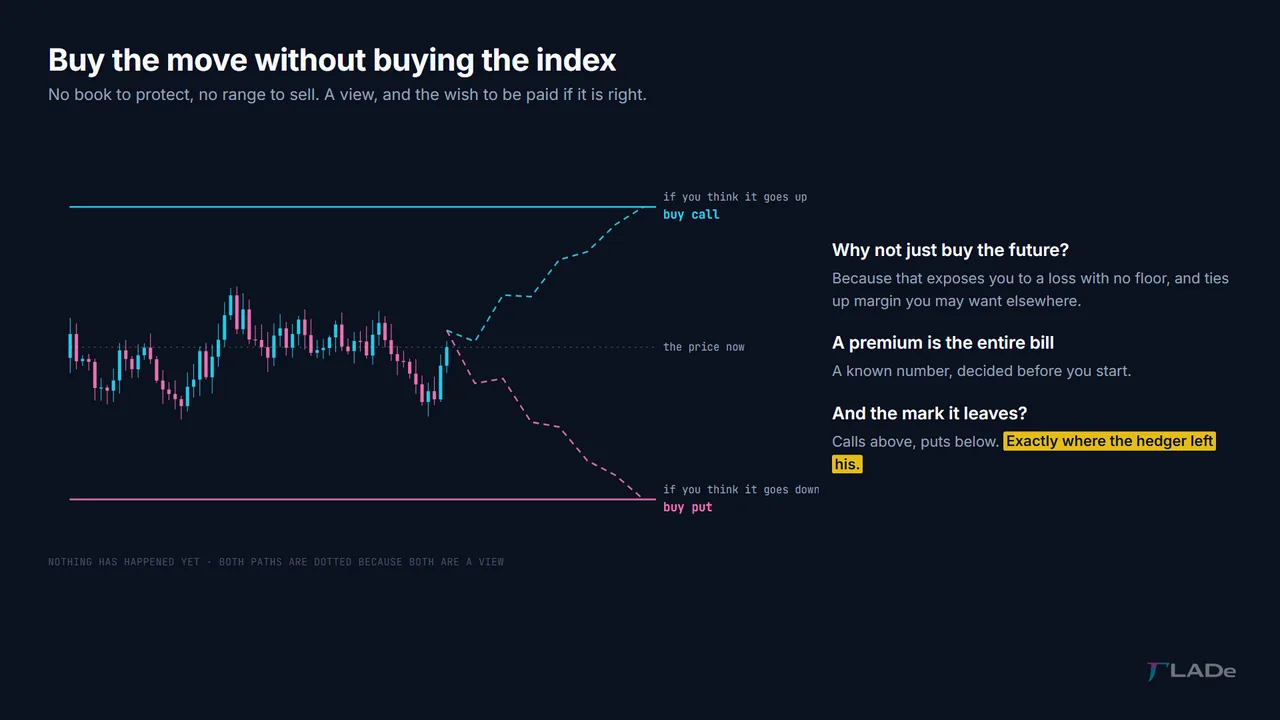
Now imagine your approach is simpler than either of those. You think you know where it goes, and you want to be exposed to it.
No book to protect, no range to sell. A view, and the wish to be paid if it is right. It is the approach most people reading this have actually run.
What do you do?
You could buy the future. That exposes you to a loss with no floor and ties up margin you may want elsewhere. Or you pay a premium — a known number, decided before you start, and that is the entire bill.
So you buy calls above the price if you think it goes up, and puts below it if you think it goes down. One intent, two directions.
Why open interest does not reveal intent
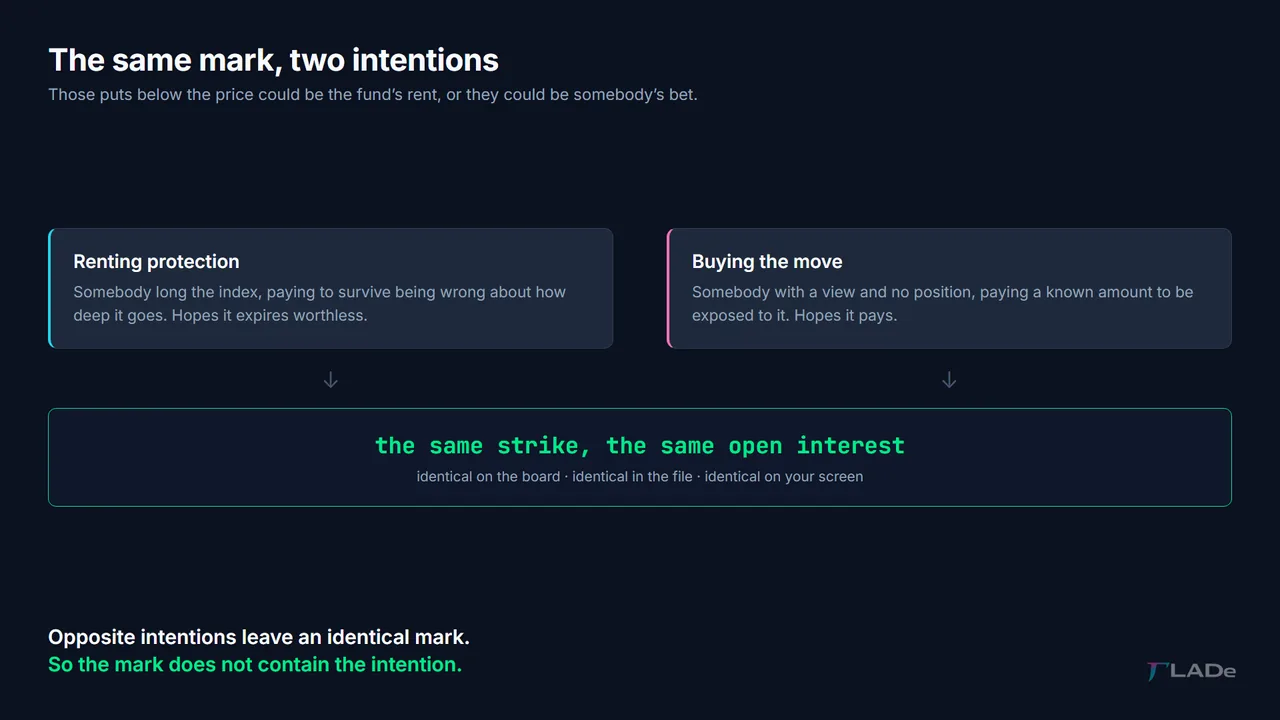
Now look at what you have left on the board. Those puts below the price could be the fund's rent, or they could be your bet. Those calls above could be the fund's collar, or they could be your bet.
The same contract, at the same strike, put there by people whose objectives have nothing in common.
Sit with that for a second, because it is the whole problem in one line. Opposite intentions leave an identical mark. Which means the mark does not contain the intention — and no amount of staring at the board will put it back.
Market makers: the dealer takes the other side
And now imagine you do not get to have an approach at all.
That is the break, and it is worth slowing down for. The three above are strategies. Anyone can run them, any day, in any combination — choose one, choose two, change your mind at lunch.
This one is not chosen. It is a mandate.
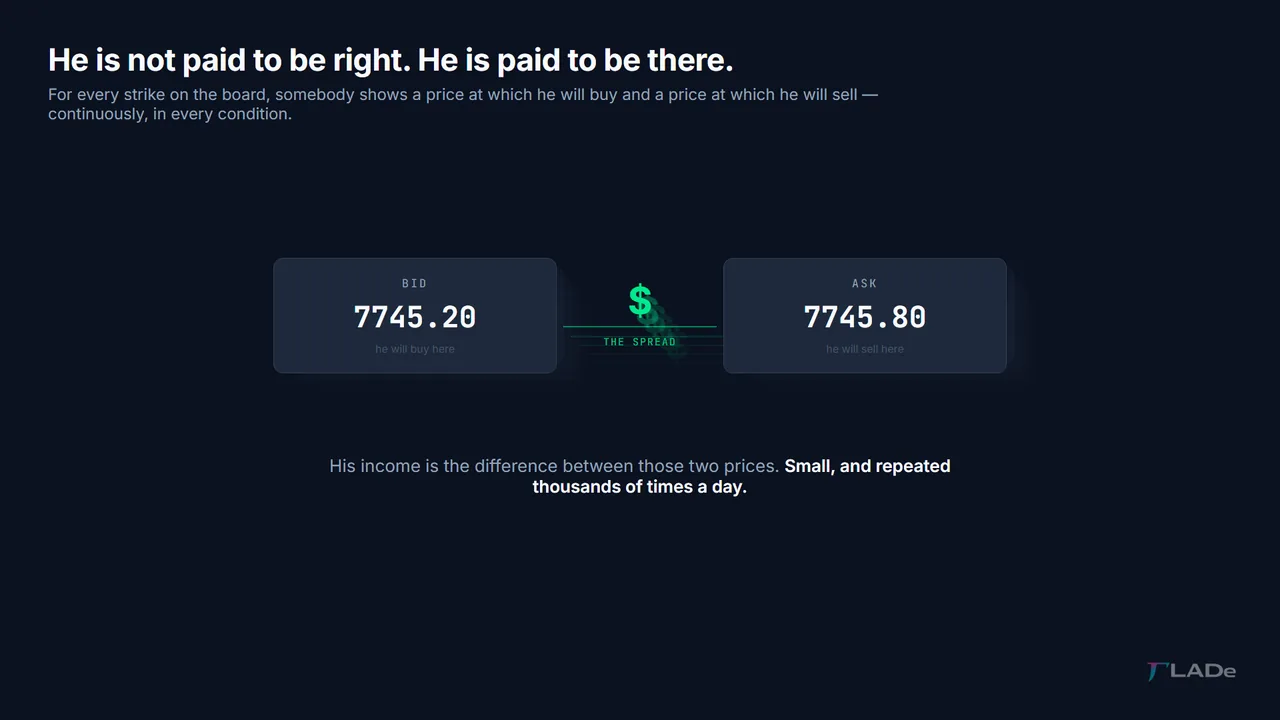
For every strike on the board, somebody shows a price at which they will buy and a price at which they will sell, continuously, in every condition. They have to, or the fund cannot buy its protection and nobody can sell a range. Some carry it as a formal obligation — designated market makers have continuous two-sided quoting requirements in the classes assigned to them. The rest quote because that is the business: stop quoting and you stop earning.
Their income is the difference between those two prices. Small, and repeated thousands of times a day.
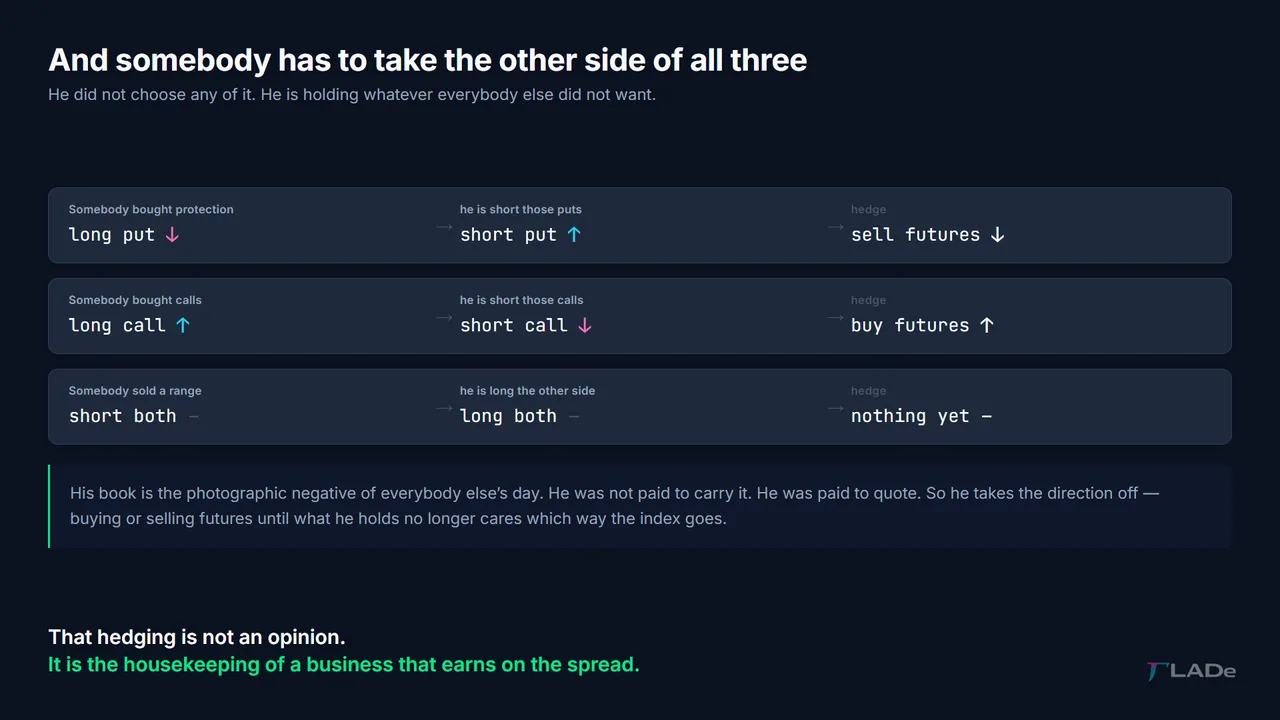
Now notice what follows. They did not choose their position. They are holding whatever everybody else did not want. The fund bought puts, so they are short those puts. Somebody bought calls for the move, so they are short those calls. Somebody sold a range, so they are long the other side of it. Their book is the photographic negative of everybody else's day.
And they were not paid to carry that. They were paid to quote. So they take the directional risk off — buying or selling futures until what they hold no longer cares which way the index goes.
That hedging is not an opinion. It is the housekeeping of a business that earns on the spread. And there is enough of it, at the same prices, every day, that it arrives on your chart looking like buyers and sellers appearing from nowhere.
One simplification, made on purpose
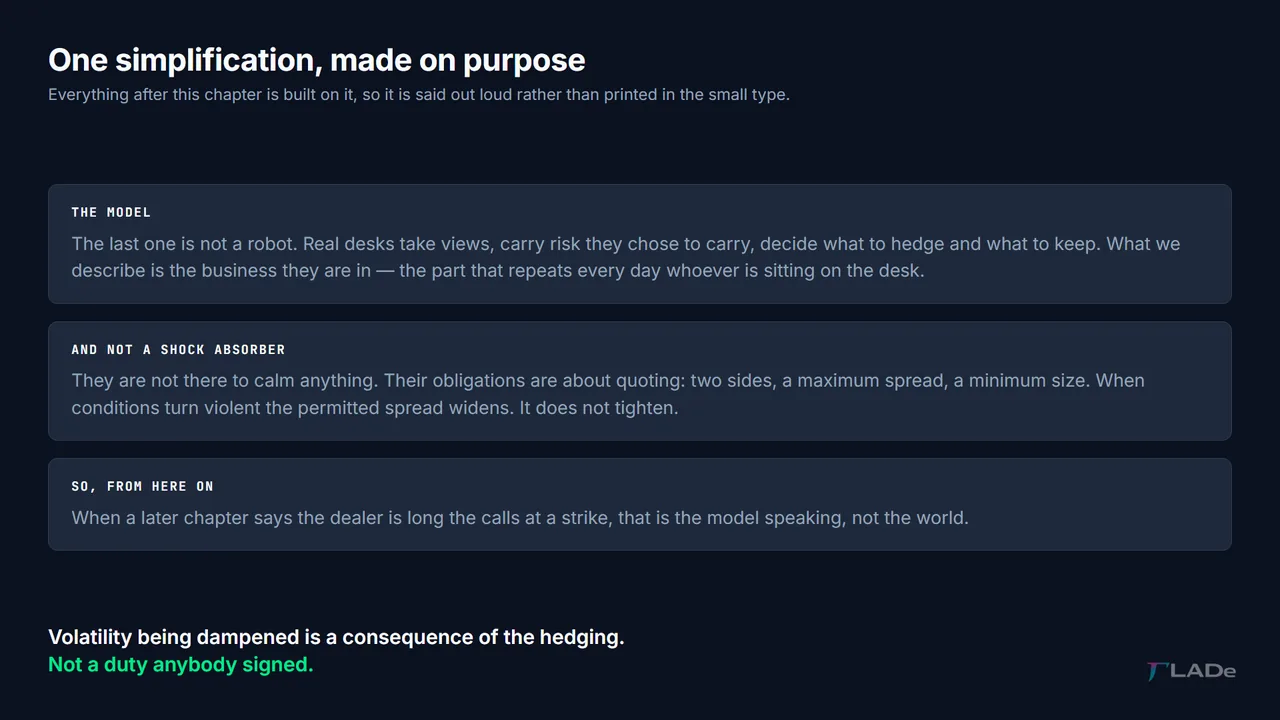
The last one is not a robot. Real desks take views. They carry risk they chose to carry. They decide what to hedge and what to keep. What we describe is the business they are in, because that is the part that repeats every day whoever is sitting on the desk.
And they are not there to calm anything. Their obligations are about quoting: two sides, a maximum spread, a minimum size. When conditions turn violent the permitted spread widens. It does not tighten. Volatility being dampened is a consequence of the hedging in this guide, not a duty anybody signed.
We use this model all the way through. So when a later chapter says the dealer is long the calls at a strike, that is the model speaking, not the world.
What the option chain does not tell you
Three examples, three different things to want. One pays to protect an exposure it already has, one is paid for being right about how far, one pays to acquire an exposure it does not have.
And one participant wants nothing at all. It has a mandate, and the mandate is to be there.
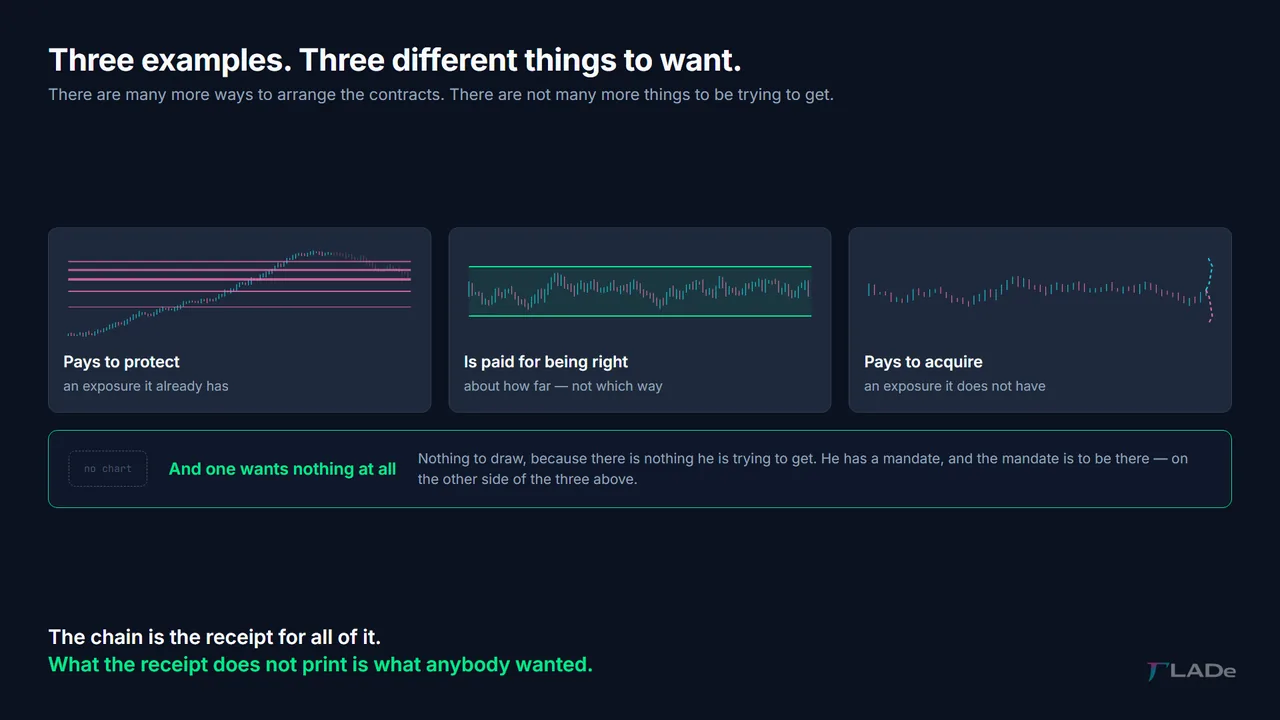
There are many more ways to arrange the contracts than the three we walked through. What there are not many of is things to be trying to get, and every contract on the board has somebody wanting one of them on one side of it. On the other side, for most of them, sits the one who never chose to be there. The chain is the receipt for all of it.
What the receipt does not print is what anybody wanted. And even if it printed the name of the firm you still would not know, because the same desk wants more than one thing at once. The name would not tell you the objective — and the objective is the only thing that changes what happens next.
One thing it does tell you, and it is the whole of the rest of this guide. The three chose. The fourth did not — and as the price moves, it does not get to choose what it does next either.